
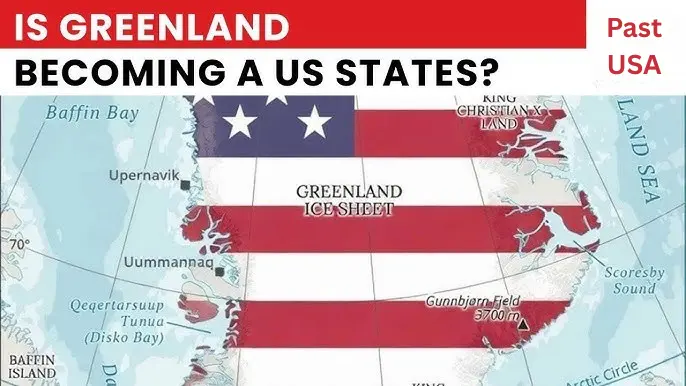
In the opening weeks of 2026, the global diplomatic stage has been rocked by a familiar yet escalating demand: the United States wants to buy Greenland. On January 17, 2026, President Donald Trump announced a series of aggressive tariffs, starting at 10% on February 1 and potentially rising to 25% by June, targeting a cluster of NATO allies including Denmark, Germany, and the UK. The goal? To force a “Complete and Total purchase” of the Arctic territory.
While the “Greenland Tariffs” of 2026 feel like a modern geopolitical shockwave, this is not a new whim. It is the continuation of a 160-year-old American obsession. From the gold-rush days of the 1860s to the Cold War calculations of Harry Truman, the story of Greenland is the story of America’s “Manifest Destiny” moving into the ice.
The 1867 Vision: Seward’s “Other” Purchase
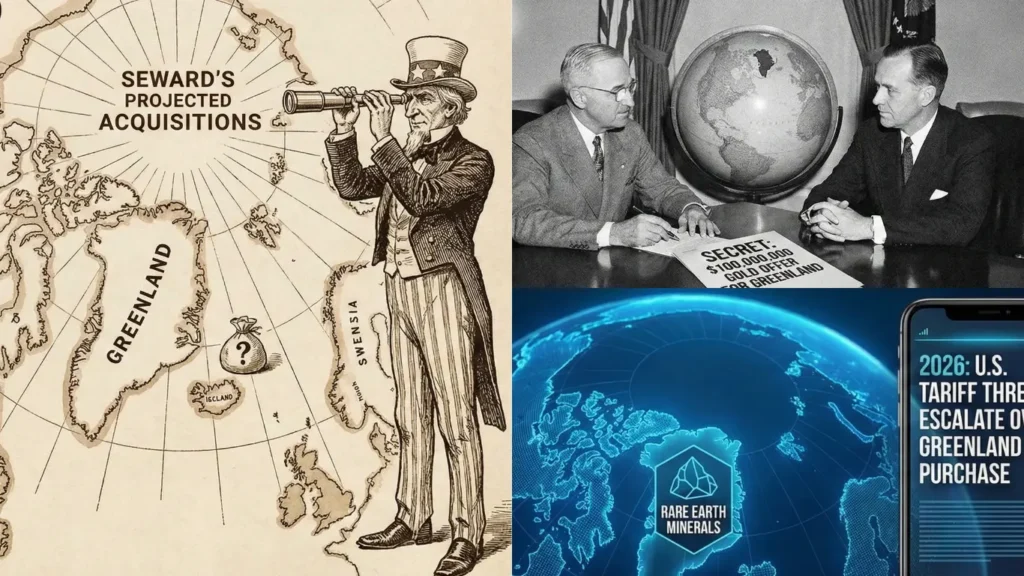
Most Americans know William H. Seward for the purchase of Alaska in 1867, often mocked at the time as “Seward’s Folly.” However, Seward’s vision for American expansion didn’t stop at the Bering Strait.
In that same year, Seward commissioned a report on the strategic value of Greenland and Iceland. He believed that control of these islands would allow the United States to dominate the North Atlantic and eventually pressure Canada into joining the Union. Although he successfully negotiated the purchase of the Danish West Indies (now the U.S. Virgin Islands), the Greenland deal stalled in a post-Civil War Congress that had lost its appetite for expensive new territories.
World War II: The Point of No Return
The U.S. interest in Greenland shifted from “expansionist dream” to “military necessity” in April 1940, when Nazi Germany occupied Denmark. For the first time, a hostile European power threatened to use Greenland as a staging ground for attacks on the North American mainland.
By April 1941, the U.S. signed a “Defense of Greenland” agreement with Henrik Kauffmann, the Danish ambassador in Washington who had gone rogue against his Nazi-occupied government. This treaty gave the U.S. the right to build military bases, including what would become the Thule Air Base (now Pituffik Space Base). Greenland essentially became a de facto U.S. protectorate for the duration of the war, providing weather data that was vital for the D-Day landings.
The 1946 Offer: $100 Million in Gold
When the war ended in 1945, Denmark expected the Americans to leave. The U.S., however, was looking at a new map of the world–one dominated by the Cold War.
In 1946, the Joint Chiefs of Staff reported that Greenland was “indispensable to the safety of the United States.” This led Secretary of State James Byrnes to make a secret, formal offer to Danish Foreign Minister Gustav Rasmussen in New York: $100 million in gold.
The U.S. even floated the idea of a land swap, offering oil-rich territory in Alaska (near Point Barrow) in exchange for Greenland. Denmark, eager to reassert its sovereignty after the trauma of Nazi occupation, politely but firmly refused.
The 2026 Context: Why Greenland Matters Now
Why has the “Greenland Question” returned with such force in 2026? It comes down to three modern factors: Minerals, Military, and The Dome.
The Rare Earth Race
In 2026, the transition to green energy and advanced AI hardware is in full swing. Greenland holds some of the world’s largest deposits of “Rare Earth Elements” (REEs), including neodymium and praseodymium, which are essential for everything from EV motors to fighter jets. Currently, China dominates this supply chain. Controlling Greenland would give the U.S. total independence from Chinese mineral markets.
“The Golden Dome” Security System
Current 2026 headlines frequently mention “The Dome”–a highly complex, multi-layered missile defense and satellite surveillance system. Because of the Earth’s curvature, Greenland is the only location that provides the “angles, metes, and bounds” required for this system to operate at maximum efficiency. To the U.S. military, Greenland isn’t just land; it’s a high-tech fortress protecting the entire Western Hemisphere.
The Melting Arctic
As Arctic ice continues to melt at record speeds, the “Northwest Passage” is becoming a viable commercial shipping route. Greenland sits at the gateway of this new global highway. Whoever controls the island controls the toll booth for 21st-century trade between Asia and Europe.
Why Denmark and Greenland Say “No”
For the people of Greenland, the discussion is not just about money–it’s about identity. Since 2009, Greenland has enjoyed “Self-Government” status within the Kingdom of Denmark. The 56,000 residents, primarily of Inuit descent, have the constitutional right to seek total independence.
Danish Prime Minister Mette Frederiksen famously called the idea of a sale “absurd” in 2019, and in 2026, the European Union has rallied behind Denmark, calling the U.S. tariff threats a “perilous game” that undermines the foundation of NATO.
Conclusion
Whether the 2026 “Greenland Tariffs” lead to a historic deal or a structural rift in the Western alliance remains to be seen. What is clear, however, is that America’s gaze toward the North is not a passing trend.
From Seward to Trump, the United States has viewed Greenland as a missing piece of its national security puzzle. As we look back at the history of, we see that the headlines of today are often just the echoes of dreams that were born over a century ago.
Pingback: 25th Amendment 2026: Strong Calls to Remove President Trump