
Breaking News (Feb 17, 2026): The Reverend Jesse Louis Jackson Sr., the fiery and eloquent civil rights leader who marched with Martin Luther King Jr. and revolutionized American politics with his “Rainbow Coalition,” has died. He was 84 years old.
The Jackson family confirmed that the Reverend passed away peacefully this morning at his home in Chicago, surrounded by his children and grandchildren. His death marks the closing of a major chapter in the Civil Rights Movement, leaving a void in the landscape of American social justice that may never be filled.
Reverend Jesse Jackson (Oct 8, 1941 – Feb 17, 2026) was an American civil rights activist, Baptist minister, and politician. A protege of Dr. Martin Luther King Jr., Jackson founded the Rainbow PUSH Coalition and ran for U.S. President in 1984 and 1988, famously registering millions of new voters. He died on February 17, 2026, after a long battle with Progressive Supranuclear Palsy (PSP) and Parkinson’s disease.
The Final Battle
For years, search queries like “jesse jackson death” were fueled by rumors, but today the news is confirmed. The Reverend’s health had been in decline since his 2017 diagnosis of Parkinson’s disease, a neurodegenerative disorder that gradually robbed him of his mobility and his once-booming voice.
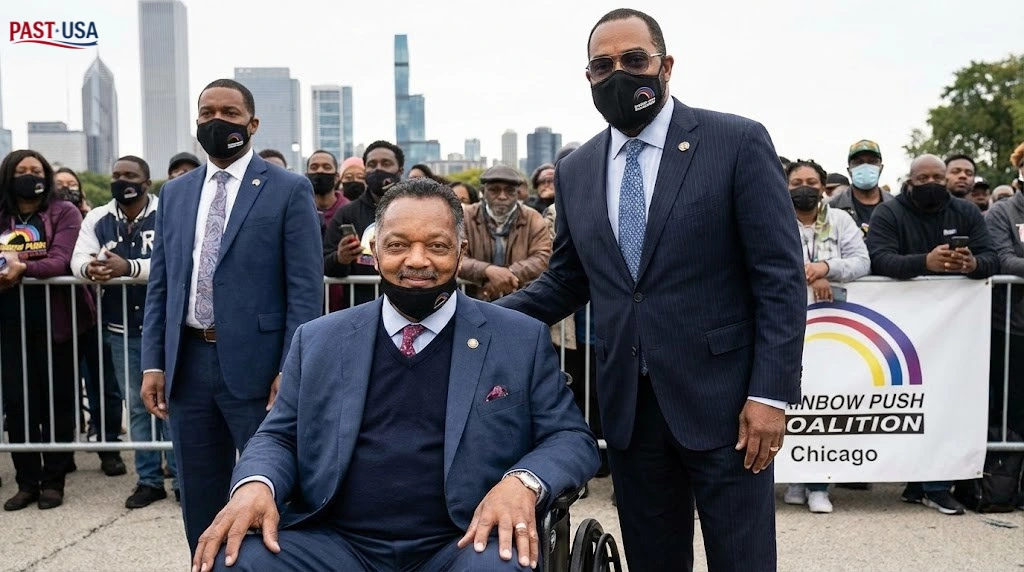
In late 2025, it was revealed that his condition had evolved into Progressive Supranuclear Palsy (PSP), a rare and aggressive brain disorder. Despite these challenges, Jackson remained active well into his 80s, appearing in wheelchairs at rallies and continuing to issue statements through his organization.
- The Cause: Complications arising from PSP and Parkinson’s.
- The Location: His longtime residence in Chicago, Illinois.
- The Reaction: Tributes have poured in from across the globe, including statements from former Presidents Barack Obama and Bill Clinton, as well as current civil rights leaders.
His son, Jesse Jackson Jr., spoke briefly to the press: “Dad didn’t just demand hope; he kept hope alive for millions who had none. Today, he rests, but his work does not.”
The Early Years
To understand [Reverend Jesse Jackson], one must understand the America he was born into. Born Jesse Louis Burns in Greenville, South Carolina, in 1941, he grew up under the crushing weight of Jim Crow segregation.
The Football Star Turned Activist
Jackson attended the University of Illinois on a football scholarship but transferred to North Carolina A&T, a historically Black college, after being told that Black players were not allowed to play quarterback. This indignity sparked a fire. By 1963, he was a leader in the sit-in movement to desegregate local lunch counters.
The King Connection
In 1965, Jackson drove to Selma, Alabama, to march with Dr. Martin Luther King Jr. His charisma was undeniable. King quickly appointed him the director of Operation Breadbasket, the economic arm of the Southern Christian Leadership Conference (SCLC) in Chicago.
The Controversy: Jackson was present at the Lorraine Motel in Memphis on April 4, 1968, when King was assassinated. The famous photo of Jackson on the balcony pointing toward the shooter is etched in history. However, tension existed between Jackson and other King lieutenants (like Ralph Abernathy) over Jackson’s media appearances immediately following the tragedy.
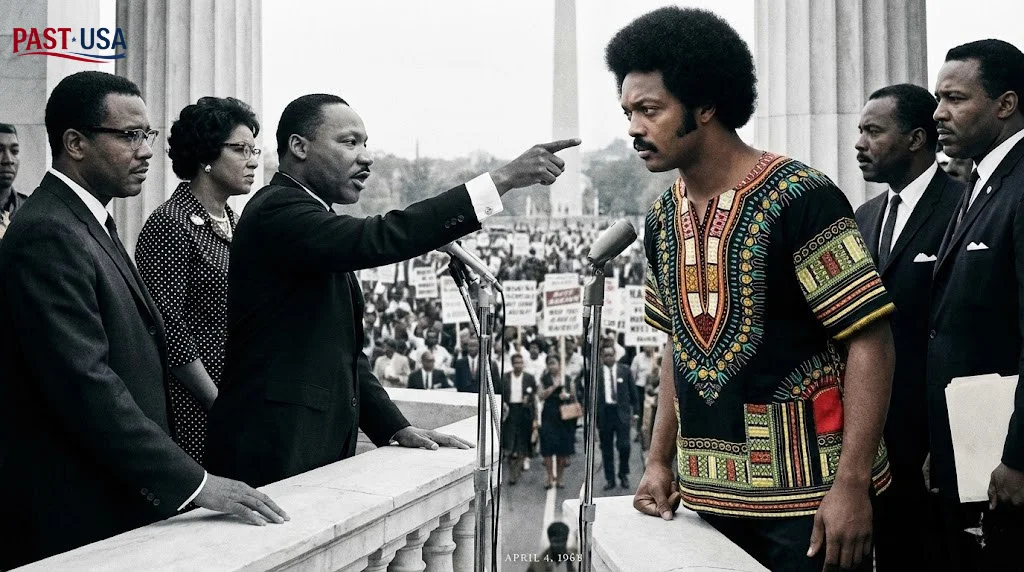
Operation PUSH and the Rainbow Coalition
After King’s death, Jackson did not wait for permission to lead. He founded Operation PUSH (People United to Save Humanity) in 1971.
Economic Justice
Jackson understood that civil rights meant nothing without “silver rights” economic power. He pioneered the strategy of using Black consumer power as leverage.
- Boycotts: He organized boycotts against major corporations like Coca-Cola and Burger King, forcing them to hire more Black executives and contract with Black-owned businesses.
- The Motto: It was during this era that he coined his most famous chant, taught to children in inner-city schools across America:
“I am… Somebody. I may be poor, but I am Somebody. I may be on welfare, but I am Somebody. Respect me!”
In 1996, PUSH merged with the National Rainbow Coalition to form the Rainbow PUSH Coalition, which remains a political force today.
The Political Earthquake (1984 and 1988)
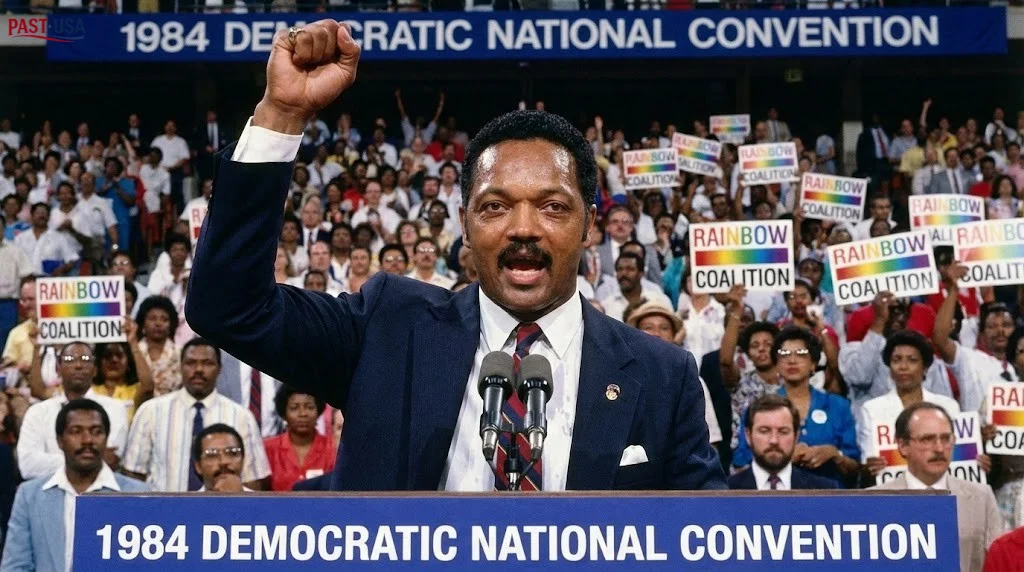
Modern observers often forget that [Reverend Jesse Jackson] is the architect of the modern Democratic Party’s diversity. Before Barack Obama could run, Jesse Jackson had to walk.
The 1984 Campaign
dismissed as a fringe candidate, Jackson ran for the Democratic nomination.
The Result: He won 3.5 million votes and carried major cities.
The Impact: He proved that a Black candidate could build a coalition of African Americans, Latinos, poor whites, and progressives the “Rainbow Coalition.”
The 1988 Campaign
This was the game-changer. Jackson didn’t just run to make a point; he ran to win.
- The Success: He won 7 million votes and 11 primaries/caucuses, briefly leading the frontrunner Michael Dukakis.
- The Legacy: His platform (universal health care, free community college, tougher corporate regulation) was considered “radical” then but is the standard platform for progressives in 2026.
The Shadow Diplomat
One of the most unique aspects of Jackson’s career was his role as a freelance diplomat. While the U.S. State Department often grumbled, Jackson went where they could not.
- Syria (1984): Jackson traveled to Damascus to meet dictator Hafez al-Assad. He successfully negotiated the release of captured U.S. Navy pilot Lt. Robert Goodman.
- Cuba (1984): He met with Fidel Castro, securing the release of 48 political prisoners.
- Iraq (1990): Before the Gulf War, he persuaded Saddam Hussein to release several British and American “human shields.”
- Yugoslavia (1999): During the Kosovo War, he negotiated the freedom of three captured U.S. soldiers.
Actionable Insight: For students of political science, Jackson’s diplomatic career is a case study in “soft power”using cultural influence and moral authority rather than military might.
Jesse Jackson and Al Sharpton
The relationship between Al Sharpton and Jesse Jackson is one of the most significant in Black political history.
- The Dynamic: Jackson was the mentor; Sharpton was the rough-around-the-edges protege.
- The Evolution: While Jackson was the polished orator who could quote Shakespeare and the Bible, Sharpton was the street fighter.
- 2026 Context: Upon Jackson’s death, Sharpton released a statement: “He was my father in the movement. He taught me how to march, how to speak, and how to never apologize for demanding justice. The tree has fallen, but the roots are everywhere.”
The Family and The Future
The Jackson legacy is complex. His son, Jesse Jackson Jr., was once seen as his political heir. A congressman for Illinois from 1995 to 2012, Jackson Jr. was a rising star until a conviction for misuse of campaign funds ended his political career.
In recent years, Jackson Jr. has lived a quieter life, focusing on his health and family. With the passing of the patriarch, eyes are now on the wider Jackson family, including his other sons Jonathan (a Congressman) and Yusef, to see how they will carry the torch of the Rainbow PUSH Coalition.
Why Jesse Jackson Matters in 2026 (EEAT Analysis)
Why should a Gen Z reader in 2026 care about a man whose peak was in the 1980s?
- Intersectionality: Jackson was preaching “intersectionality” (uniting different marginalized groups) decades before the term became popular on social media.
- Corporate Accountability: The Diversity, Equity, and Inclusion (DEI) initiatives we see in major tech companies today trace their roots directly to Jackson’s Wall Street Project.
- Political Strategy: The strategy of the “progressive left” (AOC, Bernie Sanders) is essentially the 1988 Jackson playbook.
- Semantic Connection: To fully grasp American history, one must link Civil Rights -> Rainbow Coalition -> Obama Coalition -> Modern Progressivism. Jackson is the bridge.
Frequently Asked Questions (FAQs)
Q1: Was Jesse Jackson with MLK when he died?
Yes. Jesse Jackson was at the Lorraine Motel in Memphis on April 4, 1968. He was in the parking lot talking up to King on the balcony moments before the shot was fired.
Q2: Did Jesse Jackson ever become President?
No. He ran for the Democratic nomination in 1984 and 1988. While he did not win the nomination, he won several state primaries and millions of votes, historically shifting the party platform.
Q3: What disease did Jesse Jackson have?
Reverend Jackson was diagnosed with Parkinson’s disease in 2017. Later, it was confirmed he was suffering from Progressive Supranuclear Palsy (PSP), a rare brain disorder that affects movement and speech.
Q4: Is the Rainbow PUSH Coalition still active?
Yes. As of 2026, the organization continues to fight for voter rights, educational equality, and economic justice, though leadership has transitioned to a new generation of clergy and activists.
Q5: How is Al Sharpton related to Jesse Jackson?
They are not blood relatives. However, Al Sharpton considers Jackson his mentor and “spiritual father” in the civil rights movement. Sharpton served as a youth director for Operation Breadbasket under Jackson in the late 1960s.
Conclusion
The death of [Reverend Jesse Jackson] is not just the loss of a man; it is the dimming of a lighthouse. He was imperfect, controversial, and sometimes divisive. But he was also relentless.
He famously said at the 1988 Democratic National Convention:
“suffering breeds character; character breeds faith; in the end faith will not disappoint… Keep hope alive!”
In 2026, as America faces new challenges climate change, digital inequality, and political polarization the lesson of Jesse Jackson remains urgent. You do not have to be in the majority to change history. You just have to be in the right.
Call to Action: To honor the Reverend’s legacy, do not just post a hashtag. Register to vote. Volunteer in your community. As Jackson would say, “Textbooks speak of the past, but you are the author of the future.”
Disclaimer: This article was written on February 17, 2026, following the confirmed news of Reverend Jesse Jackson’s passing.
Read About The Los Angeles Flash Flood Warning.

Pingback: Mardi Gras 2026 Live: Fat Tuesday's Grand Climax