
The skies over Los Angeles have turned a bruised shade of charcoal as the Southland grapples with one of the most ferocious weather systems to hit the region in years. If you are searching Google for information on the flash flood warning currently lighting up phones from Santa Monica to the San Gabriel Valley, you are not alone. Millions of Angelenos are currently under alert as a potent atmospheric river stalls over the coast, turning freeways into rivers and hillsides into potential mudslides.
As of Tuesday morning, the National Weather Service (NWS) has extended the flash flood warning for critical portions of Los Angeles County, emphasizing that the danger has not passed. While Monday saw the initial brunt of the storm, meteorologists warn that a “second wave” is crashing ashore today, bringing with it a renewed threat of catastrophic flooding, debris flows in burn scar areas, and chaotic travel conditions.
This comprehensive guide covers everything you need to know about the current emergency, from the science behind the storm to neighborhood-specific risks and essential survival strategies.
The Current Situation
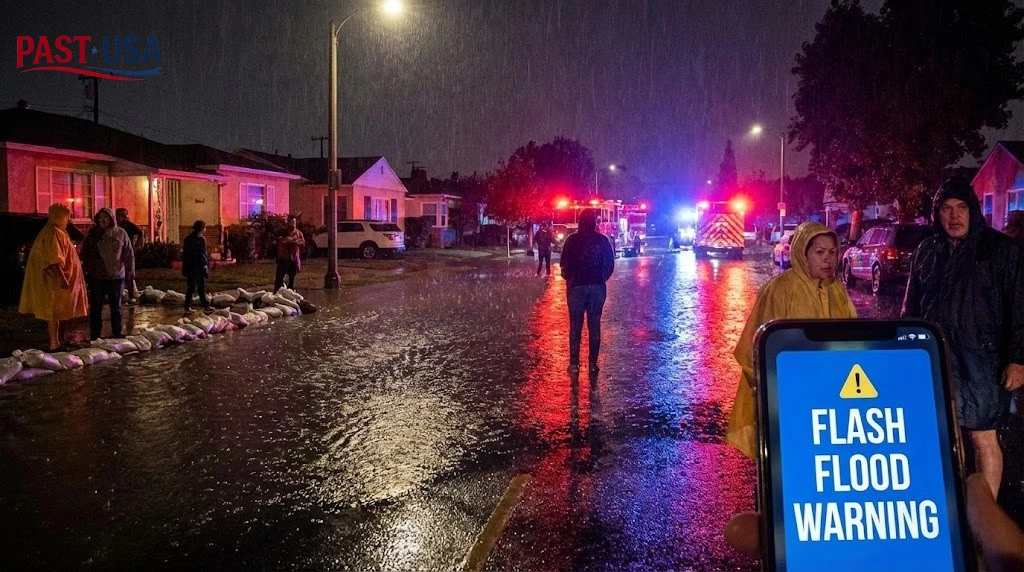
The flash flood warning currently in effect is not a drill. It represents an immediate threat to life and property. The National Weather Service in Oxnard issued the alert following sustained rainfall rates of up to 1 inch per hour in some foothills, a volume that the parched and fire-scarred earth simply cannot absorb.
“This is a dangerous situation,” the NWS warned in a bulletin early Tuesday. “Do not attempt to travel unless you are fleeing an area subject to flooding or under an evacuation order.”
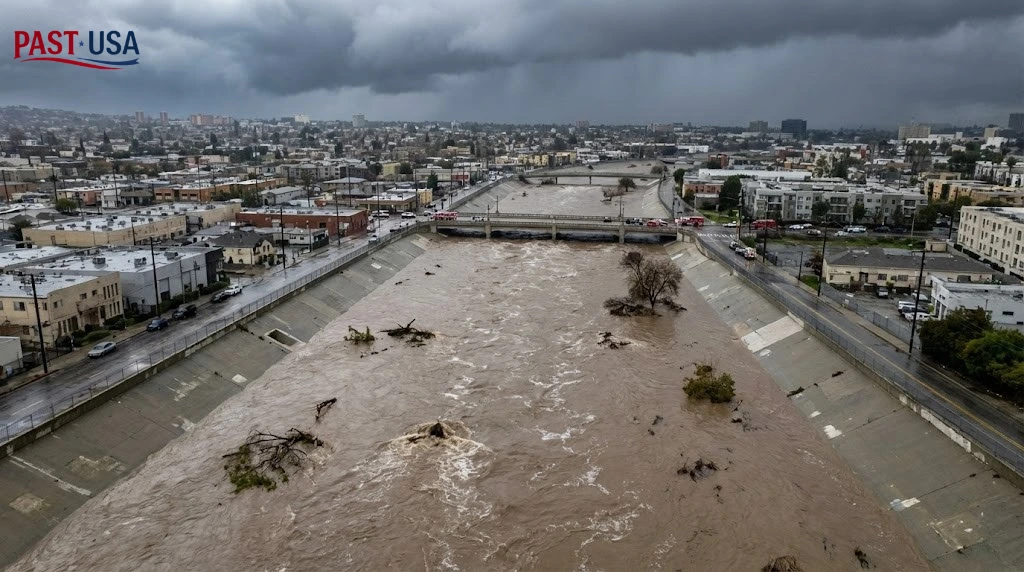
The storm, unofficially dubbed “Winter Storm Fern” by some media outlets, has already dumped between 2 to 5 inches of rain across the Los Angeles basin, with mountain totals exceeding 8 inches in localized pockets. The ground is fully saturated. Every new drop of rain that falls today becomes instant runoff, turning gutters into geysers and normally dry washes into raging torrents.
The flash flood warning covers a massive swath of the county, including:
- The Santa Monica Mountains: Where steep terrain makes mudslides a near-certainty.
- The San Fernando Valley: Particularly low-lying areas in Sepulveda Basin and along the LA River.
- Downtown Los Angeles: Where urban drainage systems are overwhelmed.
- Coastal Communities: From Malibu to Long Beach, where high tides are meeting storm runoff.
The Burn Scar Nightmare
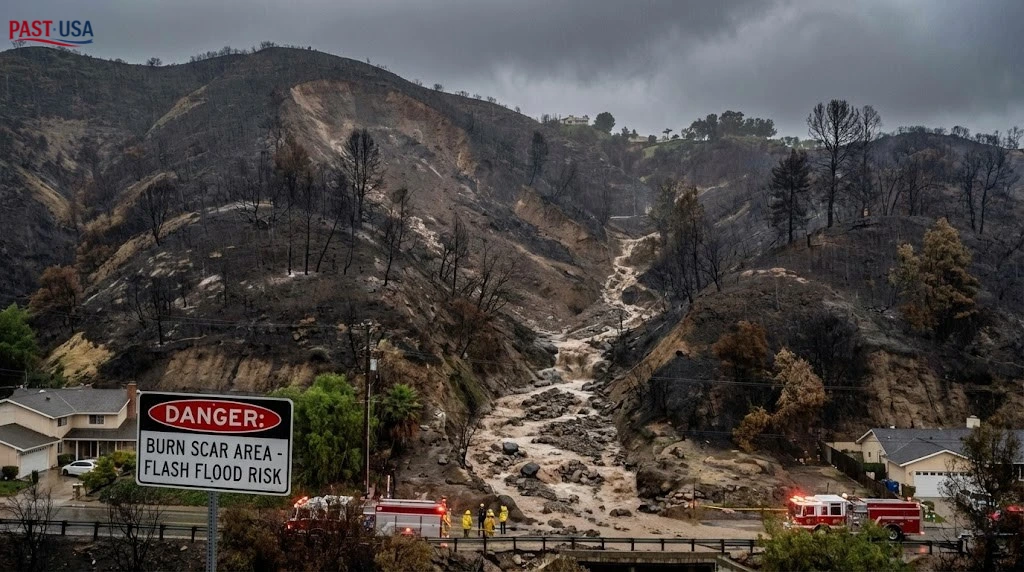
The most critical aspect of this flash flood warning involves the region’s “burn scars”areas recently devastated by wildfires. In Los Angeles, the focus is terrifyingly clear: the Palisades Fire burn scar and the Eaton Fire burn scar.
When a wildfire burns through chaparral and brush, it leaves behind a waxy, water-repellent layer of soil. Instead of soaking into the earth, rainwater slides off this surface like it’s hitting a glass table. This phenomenon, known as hydrophobic soil, creates the perfect recipe for debris flows fast-moving landslides of mud, boulders, and trees that can destroy everything in their path.
Los Angeles County officials have issued mandatory evacuation orders for select parcels near these scars. If you live near the Palisades, Sunset, or Hurst fire zones, you are in the crosshairs. The flash flood warning for these specific micro-climates is effectively a siren song for mudslides. Emergency responders have already reported minor slides in Topanga Canyon and near Pacific Coast Highway (PCH), forcing closures that have severed key arteries between the city and the coast.
The Science of the Storm
To understand why this flash flood warning is so severe, we must look at the mechanics of the storm. This is not a standard winter cold front; it is a classic “Atmospheric River” (AR).
Imagine a fire hose connected directly to the tropics, spraying moisture across the Pacific Ocean and aiming it squarely at Southern California. That is an AR. These long, narrow bands of water vapor can carry more water than the Mississippi River. When this moisture plume hits the topography of Los Angeles specifically the transverse ranges of the Santa Monica and San Gabriel Mountains it is forced upward. As the air rises, it cools and condenses, dumping its payload in the form of intense, relentless rain.
In February 2026, the conditions are exacerbated by lingering warm ocean anomalies. The Pacific is warmer than average, charging the storm with extra energy and moisture. This “thermodynamic fuel” means that the clouds are holding more water than a typical winter storm, leading to the staggering rainfall rates that triggered the flash flood warning.
Meteorologists are also tracking a phenomenon known as a “cutoff low” a low-pressure system that becomes detached from the main jet stream. These systems can stall and spin over a single area for days, pumping moisture continuously into the same battered neighborhoods. This stalling action is what transforms a rainy day into a declared disaster.
Travel Chaos
If you are planning to drive in Los Angeles today, the advice is simple: Don’t.
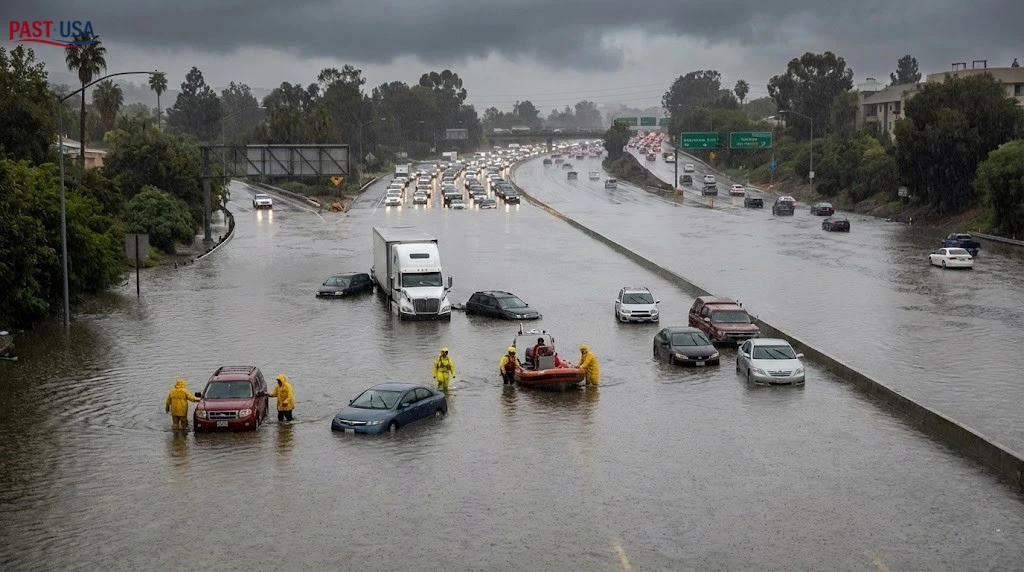
The flash flood warning has coincided with the work week, creating a nightmare scenario on the freeways. The California Highway Patrol (CHP) has reported hundreds of spin-outs and collisions since the rain began.
Key Trouble Spots
- The Sepulveda Basin: This flood-control basin is designed to fill with water to protect the rest of the valley, but it often necessitates the closure of Burbank Boulevard and Woodley Avenue. Drivers ignoring barricades here frequently require swift-water rescue.
- Pacific Coast Highway (PCH): Currently closed in multiple sections through Malibu due to mudslides and rockfall. PCH is essentially a trap during a flash flood warning.
- Interstate 5 at the Grapevine: While currently open, snow levels are dropping. The mix of heavy rain at the base and snow at the summit makes this the most dangerous pass in the state.
- Union Station/Metro: Flooding has been reported in older pedestrian tunnels, and delays are widespread across the rail network due to signal issues caused by the deluge.
LAX is also feeling the pain. While planes can fly in rain, the accompanying wind shear and lightning risks have grounded flights and caused ripple-effect delays across the country. If you are flying out of LAX, check your flight status before leaving home.
Urban Flooding
While the mountains face mudslides, the urban core of Los Angeles is facing a different beast: street flooding. The city’s concrete jungle is largely impermeable. We have paved over the sponges that nature provided.
During a flash flood warning, intersections in low-lying areas of West Hollywood, Culver City, and even Beverly Hills can transform into lakes within minutes. This isn’t just water; it’s a toxic stew of runoff, oil, trash, and bacteria.
The NWS reminds drivers of the mantra: “Turn Around, Don’t Drown.” It takes only six inches of fast-moving water to knock over an adult, and only twelve inches to carry away a small car. Yet, every time a flash flood warning is issued, news helicopters capture footage of drivers attempting to ford flooded underpasses, often with disastrous results. Do not be the lead story on the 6 PM news.
Historical Context
Long-time Angelenos will recall the El Nino storms of 1998 or the relentless rains of 2005. How does the February 2026 storm compare?
While it is too early to calculate final rainfall totals, the intensity of this system rivals the historic storms of the past. The danger is compounded by the “whiplash” weather patterns we now experience due to climate change. We swing violently from extreme drought to extreme deluge. The soil, stressed by dry spells, is less capable of absorbing the shock of a sudden flash flood warning event.
In 1938, a massive flood killed over 100 people in Los Angeles and spurred the channelization of the LA River. While our infrastructure is better today, the concrete straitjacket we put the river in speeds up the water, sending it rocketing toward the ocean at breakneck speeds. During a flash flood warning, the LA River usually a trickle becomes a raging, lethal monster. Stay away from the riverbeds.
Survival Guide
If you are in a flash flood warning zone, your actions in the next few hours matter.
- Heed Evacuation Orders: If authorities say go, go. Debris flows can move at 30 mph. You cannot outrun them.
- Prepare a “Go-Bag”: Include medications, important documents, chargers, water, and non-perishable food.
- Charge Your Devices: Power outages are likely as soil saturation topples trees onto power lines.
- Clear Your Drains: If it is safe to do so, ensure your backyard drains are clear of leaves. A blocked drain is the number one cause of localized home flooding.
- Monitor Official Channels: Do not rely on rumors. Follow the NWS Los Angeles (@NWSLosAngeles) and local fire departments for real-time updates on the flash flood warning.
The Human Toll: Shelter and Support
The city has opened emergency shelters for those displaced by the storm, particularly the unhoused population who often reside in the dangerous flood channels of the LA River. Outreach teams have been deployed to urge people to seek higher ground, but the rapid onset of the flash flood warning makes these rescue operations incredibly high-risk.
Community centers in the San Fernando Valley and Westside are operating as temporary refuges. If you need assistance, dial 3-1-1 for city services or 9-1-1 for life-threatening emergencies.
When Will It End?
The current forecast suggests that the atmospheric river will begin to taper off by late Wednesday evening, but the threat will linger. The ground will remain saturated for weeks. Even after the rain stops and the flash flood warning expires, the risk of “delayed” landslides remains high. Hillsides can give way days after the sun comes out as gravity finally wins the battle against the water-logged soil.
Furthermore, a secondary, colder system is trailing behind this one, bringing the potential for lower snow levels and more instability later in the week. This is a multi-round fight.
Conclusion
As Los Angeles weathers this storm, the primary message is one of respect. We often dismiss weather in Southern California as a nuisance, but a flash flood warning is a declaration of nature’s power. The infrastructure of our sprawling metropolis is being tested, and the margins for error are razor-thin.
Stay inside, stay off the roads, and stay safe. The sun will shine again on Los Angeles it always doesbut until the waters recede, vigilance is our only defense against the storm.
Checkout the Latest Post about the death of Legendary Robert Duvall.

Pingback: Reverend Jesse Jackson Passes Away Peacefully at 85