

The digital landscape of 2026 is a volatile ecosystem where reality and fabrication frequently collide, creating perfect storms of viral misinformation. Recently, the American internet was set ablaze by a seemingly innocuous event happening across the Atlantic: the 51st Cesar Awards in Paris, France. What was meant to be a prestigious celebration of a Hollywood veteran’s lifetime of cinematic achievements rapidly devolved into one of the most bizarre, trending conspiracy theories of the decade. The focal point of this digital maelstrom? A beloved Canadian-American star who made a rare public appearance, only to have the global public question his very identity.
This article delves deep into the anatomy of this viral phenomenon. We will explore the timeline of the Paris appearance, the psychological triggers that caused millions of American social media users to suspect a celebrity cloning operation, the intervention of a highly skilled makeup artist that threw gasoline on the fire, and the official responses that attempted to restore order. Furthermore, we will contextualize this bizarre moment by looking back at the unparalleled career of the comedy icon at the center of the storm, analyzing why the public remains so fiercely protective and intensely scrutinizing of his legacy.
The Night in Paris
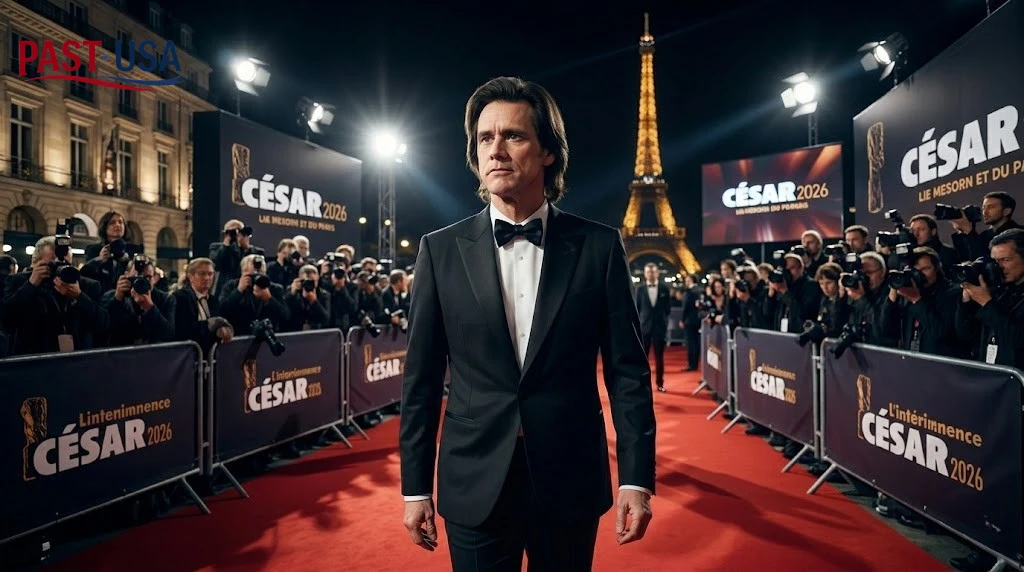
To understand the sheer magnitude of the current trending search data in the United States, one must first look at the inciting incident. On February 26, 2026, the global film community gathered in Paris for the Cesar Awards, widely regarded as the French equivalent of the Oscars. The evening was designed to honor international excellence in cinema, with a special Cesar d’honneur (Honorary Cesar) awarded for lifetime achievement.
When the guest of honor arrived, the atmosphere shifted. The 64-year-old actor, known for his decades of high-energy, physical comedy and deeply emotional dramatic turns, stepped onto the red carpet looking noticeably different from his last major public outing at the Rock & Roll Hall of Fame in November 2025. Jim Carrey was adorned in a sleek, understated black tuxedo, paired with a button-up black shirt and a matching bow tie. However, it was his grooming and facial features that immediately caught the attention of the paparazzi and the global audience watching via livestreams.
Gone was the short, slicked-back hair and the rugged beard that had characterized his “sabbatical” era. In its place was shoulder-length, dark hair, parted neatly down the middle. His face appeared remarkably smooth, and his signature hyper-expressive features seemed, to some viewers at least, somewhat subdued.
During the ceremony, the celebrated actor took to the stage to accept his award. In a touching display of respect for his host country, Jim Carrey delivered a highly emotional, deeply personal acceptance speech entirely in French. Jim Carrey paid tribute to his late father, Percy Joseph, crediting him for instilling the values of love, generosity, and laughter. Jim Carrey also acknowledged his “sublime companion,” Min Ah, his daughter Jane, and his grandson Jackson. Jim Carrey ended the speech with his trademark self-awareness, joking, “How was my French? Almost mediocre, right?”
By all traditional metrics, it was a triumphant return to the spotlight. It was a moment of grace, elegance, and international recognition. Yet, as clips of the speech and the red carpet interviews began to circulate on platforms like X (formerly Twitter), TikTok, and Instagram, the narrative took a sharp, unexpected turn.
The Anatomy of a Modern Internet Conspiracy

The modern internet operates on a currency of skepticism, fueled by the rapid advancement of artificial intelligence, deepfakes, and a general distrust of media narratives. When the footage from the Cesar Awards reached the United States, it did not trigger waves of nostalgia; instead, it triggered an avalanche of paranoia.
Almost immediately, the comment sections beneath the viral clips were inundated with statements of disbelief. Users scrutinized the footage pixel by pixel. “The eyes are off. There’s no soul. That’s how you recognize a clone,” read one highly engaged comment. Others pointed to his seemingly altered posture, the smoothness of his skin, and the structural appearance of his jawline.
The theories quickly bifurcated into two distinct camps:
- The Extreme Cosmetic Alteration Theory: A large contingent of users argued that the comedy legend had simply succumbed to the pressures of aging in the public eye. They speculated about upper blepharoplasty (eyelid surgery), facelifts, and extensive use of dermal fillers. They argued that a man whose entire career was built on the elasticity of a “rubber face” had tragically paralyzed his most valuable asset in an attempt to turn back the clock.
- The Imposter/Clone Theory: The more viral, and significantly more extreme, theory posited that the man on stage in Paris was an imposter, a body double, or a literal clone. Proponents of this theory cited the actor’s historical anti-Hollywood sentiments, his vocal critiques of corporate control in the entertainment industry, and his well-documented struggles with depression as “evidence” that the establishment had somehow replaced him with a compliant duplicate.
This reaction highlights a fascinating sociological phenomenon: pareidolia, but applied to celebrity familiarity. The American public has spent forty years memorizing the exact topography of this specific actor’s face. Every wrinkle, every exaggerated grimace, and every micro-expression has been burned into the cultural subconscious through endless rewatches of 1990s blockbusters. When presented with a version of that face that has naturally aged, altered its grooming habits, and perhaps undergone mild, standard Hollywood maintenance, the collective brain rejects the image. It is easier for the internet to process a sprawling sci-fi cloning conspiracy than to accept the simple, mundane reality of human aging and stylistic change.
The Alexis Stone Intervention: Pouring Gasoline on the Fire
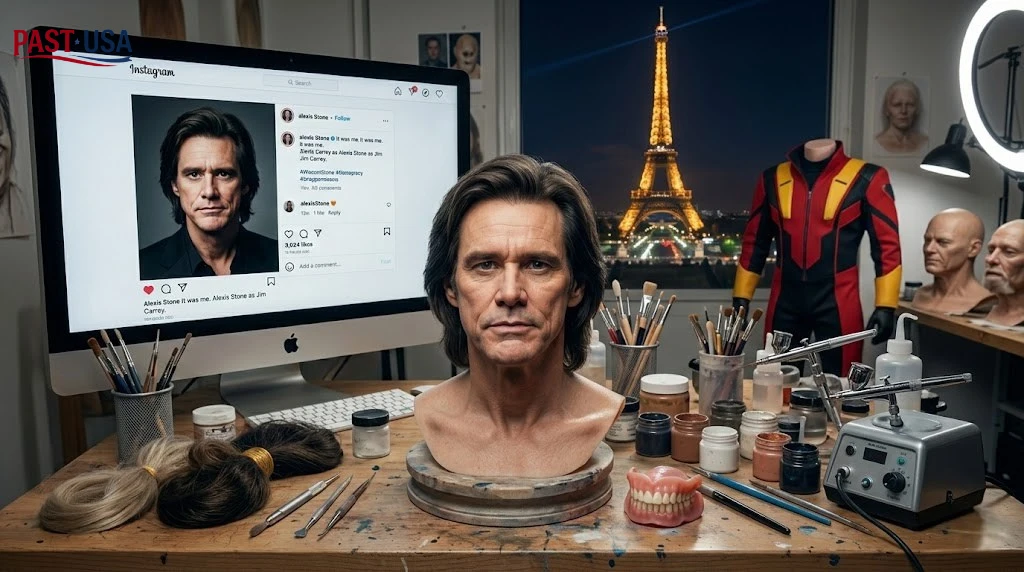
If the internet was a smoldering fire of speculation, an Instagram post made a few days later was the barrel of gasoline that caused the explosion, rocketing the search term to the top of Google in the USA.
Alexis Stone, a highly prominent drag performer and makeup artist renowned for executing hyper-realistic celebrity transformations, entered the chat. Stone has a well-documented history of using advanced prosthetics, masterful contouring, and theatrical wigs to perfectly mimic the appearances of icons like Glenn Close, Anna Wintour, and Lana Del Rey, often fooling paparazzi in the process.
At the height of the Cesar Awards controversy, Stone posted a carousel of images on Instagram. The post included red-carpet photos from the Paris event, a picture seemingly taken inside the award venue, and crucially an image of a hyper-realistic silicone face mask, complete with a dark wig and a set of fake teeth, resting on a table with the Eiffel Tower in the background. The caption was simple, direct, and incredibly provocative: “Alexis Stone as Jim Carrey in Paris.”
The internet completely fractured. For the conspiracy theorists, this was the ultimate smoking gun. It validated their wildest suspicions: the man on stage wasn’t the real actor; it was a performance art stunt executed by a master of disguise. Major news outlets began picking up the story, and the buzz became deafening.
However, critical thinkers quickly began to poke holes in Stone’s claim. They pointed out several logical fallacies:
- The Speech: The individual on stage delivered a nuanced, emotional speech in French, displaying genuine tears and specific vocal cadences that are incredibly difficult to replicate, even with a mask.
- The Facial Mobility: While accepting the award, the honoree utilized his trademark facial contortions, flashing wide smiles and raising his eyebrows movements that a stiff silicone mask would prohibit or severely distort.
- The AI Factor: Several digital forensics enthusiasts quickly pointed out visual artifacts in Stone’s mask photo, suggesting the “evidence” itself may have been generated by Artificial Intelligence as a brilliant, engagement-farming prank.
Stone is known for releasing detailed, long-form YouTube documentaries breaking down the prosthetic process after a successful stunt. As days passed without such a video, the consensus began to shift toward the realization that the public had been brilliantly trolled by an opportunistic artist capitalizing on an existing viral moment.
The Official Rebuttal: Setting the Record Straight
As the conspiracy theories reached a fever pitch, threatening to completely overshadow the prestige of the Cesar Awards, official representatives were forced to step in and forcefully guide the narrative back to reality.
Gregory Caulier, the general delegate of the Cesar Awards, issued a comprehensive statement to Variety to completely debunk the cloning and imposter rumors. Caulier expressed frustration that a deeply profound and historic moment for French cinema was being reduced to a bizarre internet meme.
According to Caulier, the actor’s attendance had been meticulously planned since the summer of 2025. This was not a last-minute stunt. “Eight months of ongoing, constructive discussions,” Caulier noted. Jim Carrey revealed that the Hollywood icon had worked diligently on his French speech for months, constantly communicating with the organizers to ensure his pronunciation was respectful and accurate.
Furthermore, the logistical reality of the event made the imposter theory completely unviable. The award recipient did not arrive alone; Jim Carrey was accompanied by an entourage of sixteen people. This included his partner, his daughter, his grandson, his longtime publicist, and a dozen close friends and family members, including frequent collaborator and director Michel Gondry. The idea that a makeup artist in a silicone mask could fool the actor’s own daughter, grandson, and closest friends for an entire evening is, frankly, absurd.
The star’s own representatives also released emphatic statements to major news outlets, confirming without a shadow of a doubt that the man who walked the red carpet and delivered the emotional speech was, in fact, the genuine article. The “unrecognizable” look was simply the result of a man in his sixties trying out a new hairstyle, wearing formal attire, and navigating the natural progression of time.
A Retrospective: The Man Behind the Rubber Face
To fully grasp why the American public reacted with such visceral panic to the idea of this specific star being “replaced,” one must examine the unparalleled cultural real estate Jim Carrey occupies in the millennial and Generation X consciousness.
The year 1994 remains a legendary anomaly in Hollywood history. Within a span of twelve months, this singular performer headlined three massive blockbuster comedies: a movie about a pet detective, a comic-book adaptation about a magical green mask, and a buddy-comedy about two profoundly unintelligent friends traveling to Aspen. These films did not just make money; they fundamentally altered the comedic landscape. They grossed hundreds of millions of dollars globally and cemented his status as the highest-paid comedic actor of his generation.
His appeal was rooted in a type of hyper-kinetic physical comedy that had not been seen since the silent film era of Charlie Chaplin or Buster Keaton. His body was seemingly made of elastic, and his face could contort into impossible, cartoonish expressions that defied anatomical logic. Jim Carrey was a living, breathing cartoon character, possessing a manic energy that was wildly infectious.
However, this level of physical exertion and the demand to constantly be the most energetic person in the room takes a monumental toll on the human psyche and the physical body. The public began to view him not as a complex human being, but as a reliable, ever-smiling entertainment machine. When the machine began to show signs of wear, or when the man behind the machine decided Jim Carrey wanted to be something else, the public experienced a profound sense of cognitive dissonance.
The Shift to Dramatic Brilliance and Existential Questions
The transition from broad physical comedy to deeply affecting dramatic work is a perilous journey for any actor, but it is one this particular star navigated with astonishing brilliance. As the late 1990s approached, Jim Carrey began actively dismantling the “funny man” persona that had made him a global superstar.
His lead performance in the 1998 satirical psychological drama The Truman Show was a watershed moment. Playing a man whose entire life is unknowingly broadcast as a reality television show, Jim Carrey tapped into a well of profound existential dread and vulnerability. The irony of this performance, when viewed through the lens of the 2026 cloning conspiracy, is incredibly rich. Jim Carrey starred in a masterpiece about a man trying to escape a fake, manufactured reality created by the media, only to find himself, decades later, accused by the media of being a fake, manufactured entity himself.
He followed this up with an astonishing, Golden Globe-winning transformation into the avant-garde comedian Andy Kaufman in Man on the Moon (1999), a role that blurred the lines of identity so severely that it reportedly triggered a temporary psychological crisis for the actor himself. Later, his heartbreaking, understated work in Eternal Sunshine of the Spotless Mind (2004) proved conclusively that his emotional depth was just as boundless as his physical comedic abilities.
These dramatic roles revealed a deeply sensitive, philosophically inquisitive artist. They laid the groundwork for the man who would eventually step away from the Hollywood machine to seek a quieter, more introspective life.
The Sabbatical: Art, Philosophy, and Stepping Away
In the late 2010s and early 2020s, the once-ubiquitous movie star began a deliberate and highly publicized retreat from the entertainment industry. Jim Carrey openly expressed a deep disillusionment with the corporate machinery of Hollywood, stating in interviews that Jim Carrey no longer wanted to be part of a business where committees dictated creativity to appeal to “four-quadrant” demographics.
He found solace and absolute creative control in visual arts, specifically painting and political cartooning. Documentaries released during this era showcased a man who had traded the manic energy of soundstages for the quiet solitude of an art studio. Jim Carrey grew a thick beard, spoke extensively about spirituality and ego-death, and seemed to have genuinely detached himself from the desperate need for public validation that drives so many performers.
“I have enough. I’ve done enough. I am enough,” Jim Carrey famously stated in a 2022 interview, suggesting that he was entering a phase of permanent retirement, or what Jim Carrey later dubbed a “power rest.” He maintained that Jim Carrey would only return to acting if a script written in “gold ink” arrived, presenting a project that was truly important for the world to see.
This philosophical detachment makes the recent internet hysteria all the more poignant. The public, conditioned to demand endless content from its icons, struggles to accept a star who simply wishes to exist quietly as a private citizen. The clone conspiracy is, in a psychological sense, a defense mechanism a way for fans to rationalize why the energetic superstar of their youth has been replaced by a quiet, contemplative artist.
The Return of Robotnik and the Future of the Icon

Despite his vocal desires for a quiet life, the allure of pure, unadulterated fun (and undoubtedly, massive studio paychecks) eventually coaxed him back to the silver screen. In 2020, Jim Carrey found a new generation of fans by stepping into the role of the villainous Dr. Robotnik in the live-action Sonic the Hedgehog franchise.
The role was a triumphant return to form, allowing him to tap into the exaggerated, mustache-twirling physical comedy of his early career, but with the refined control of a seasoned veteran. The immense box-office success of the first film led to a sequel in 2022, and Jim Carrey reprised the role once again in Sonic the Hedgehog 3, which dominated the box office in late 2024.
During the promotional tour for the third installment, Jim Carrey candidly joked to reporters about his return from “retirement,” stating bluntly, “I need the money, frankly.” This refreshing honesty is indicative of his current relationship with Hollywood: Jim Carrey views it not as an identity-defining calling, but as a job he can occasionally dip into when it suits him. With reports confirming that Jim Carrey is set to return for Sonic 4 in 2027, it is clear that his professional relationship with the camera is far from over, even if his relationship with the red-carpet celebrity circuit remains strained.
Conclusion
The bizarre saga of the 2026 Cesar Awards and the subsequent American internet meltdown is ultimately a story about the heavy burden of extreme fame. When you possess one of the most recognizable and beloved faces on the planet, that face ceases to belong entirely to you; it becomes the property of the public imagination.
The viral panic surrounding his Paris appearance was not born of malice, but of a deeply misguided nostalgia. The internet saw a beloved artist who had aged, who had changed his hairstyle, and who was displaying the quiet dignity of a man in his mid-sixties, and the internet simply refused to compute the data.
The truth is far less sensational than silicone masks or Hollywood cloning facilities. The truth is that Jim Carrey is simply a human being. Jim Carrey is an artist who has given decades of his life to making the world laugh, cry, and think. Jim Carrey has earned the right to grow his hair out, to wear a tuxedo in Paris, to give an emotional speech in a second language, and to age gracefully without the global public demanding a sci-fi explanation for the passage of time. As the trending searches eventually fade and the internet moves on to its next collective obsession, the legacy of this unmatched comedic genius will remain perfectly intact real, evolving, and entirely his own.
Read about Zendaya and Tom Holland’s Wedding.