
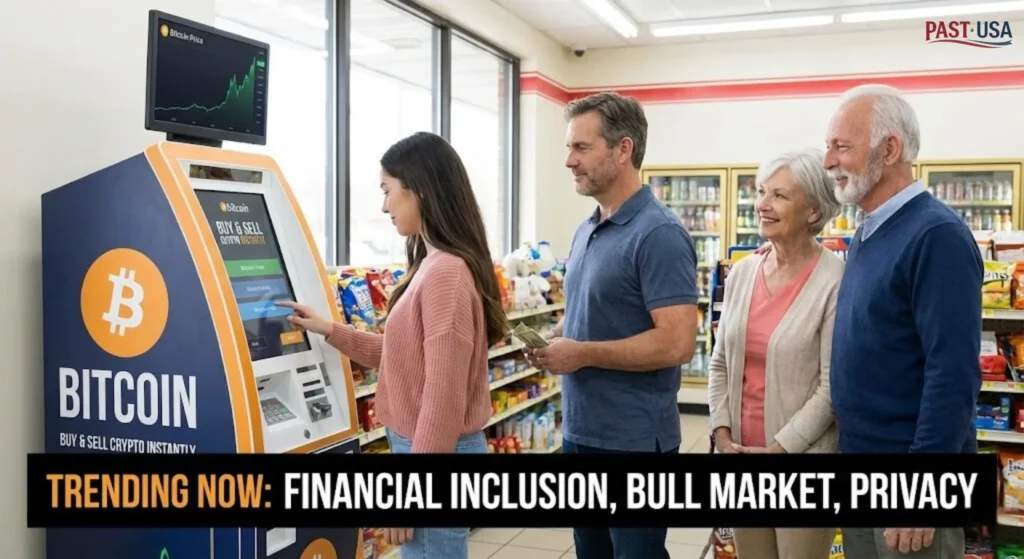
In the bustling landscape of American finance, a new fixture has quietly taken residence next to the Redbox machines and lottery kiosks in your local gas stations and grocery stores: the Crypto ATM. As Bitcoin surges past historic milestones and digital assets become increasingly integrated into the mainstream economy, searches for “Crypto ATM” and “Bitcoin ATM” are trending across the United States.
Whether you are a seasoned investor looking for a quick way to liquidate assets or a curious beginner holding your first $20 bill destined for the blockchain, these machines represent the physical bridge between fiat currency and the digital future. However, with their rise comes a wave of questions regarding fees, safety, regulations, and the ever-present threat of fraud.
This extensive guide will walk you through everything you need to know about the Bitcoin ATM ecosystem in 2026, exploring why they are trending, how to use them, and crucially, how to keep your money safe.
What is a Crypto ATM?
At first glance, a Crypto ATM looks remarkably similar to the traditional bank ATMs we have used for decades. It has a screen, a keypad, and a slot for cash. However, the internal mechanics and the purpose of the machine are fundamentally different.
A traditional automated teller machine (ATM) connects to your bank account, allowing you to withdraw physical cash from your existing digital balance. A Bitcoin ATM (often abbreviated as BTM) connects directly to a cryptocurrency exchange via the internet. It does not connect to your bank account. Instead, it is a portal that facilitates a blockchain transaction.
Types of Machines
When you search for a “Bitcoin ATM near me,” you will generally encounter two types of kiosks:
- Unidirectional (One-Way) Machines: These are the most common, accounting for roughly 70% of the market. They allow you to insert cash (fiat currency) to purchase cryptocurrency, which is then sent to your digital wallet. You cannot withdraw cash from these units.
- Bidirectional (Two-Way) Machines: These are the true “ATMs” of the crypto world. They allow you to both buy crypto with cash and sell your crypto to withdraw cash. These are less common due to the higher capital requirements for the operators (they need to keep the machine stocked with cash) and stricter regulatory hurdles.
While Bitcoin is the primary asset supported, most modern machines are actually a Crypto ATM, offering a variety of coins including Ethereum (ETH), Litecoin (LTC), and Dogecoin (DOGE).
Why Are Crypto ATMs Trending Now?
The search interest in “Crypto ATM” hasn’t spiked by accident. Several converging factors in 2025 and early 2026 have driven this technology into the spotlight.
The “Unbanked” and Financial Inclusion
For millions of Americans who are “unbanked” or “underbanked” meaning they lack access to traditional banking services due to credit history or lack of documentation a Crypto ATM offers a lifeline. These machines provide a way to participate in the digital economy without needing a checking account or a credit score. It allows for the digitization of cash in a way that was previously impossible.
The Bull Market Effect
With Bitcoin recently shattering price records (surpassing the $100k mark in late 2024/early 2025), public interest has reignited. When the price of Bitcoin dominates the news cycle, new investors rush to buy in. For many, the barrier to entry for online exchanges which often require linking bank accounts and waiting days for transfers is too high. A Bitcoin ATM offers instant gratification. You insert cash, and you own Bitcoin minutes later.
Privacy Concerns
While not anonymous, Crypto ATMs are often perceived as more private than centralized exchanges like Coinbase or Kraken. While you must still provide identification (more on that later), you do not have to link your primary bank account, keeping your crypto activity somewhat segmented from your monthly bank statement.
How to Use a Bitcoin ATM: A Step-by-Step Guide
Using a Bitcoin ATM is designed to be intuitive, but the process can be intimidating for a first-time user. If you go in unprepared, you might find yourself standing in a convenience store fumbling with your phone while a line forms behind you.
Here is a foolproof walkthrough to ensure your transaction goes smoothly.
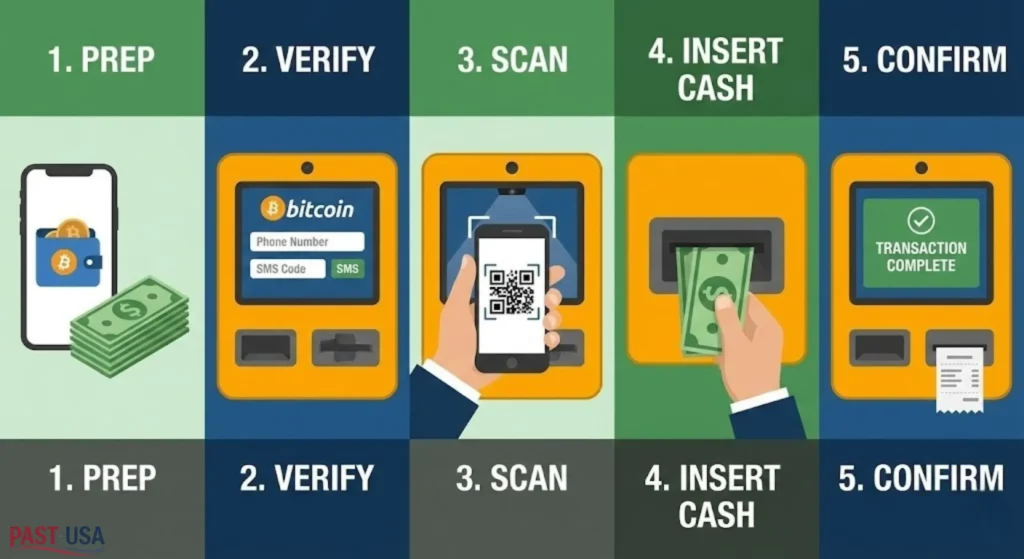
Step 1: Preparation (Before You Leave Home)
Do not walk up to the machine empty-handed. You need three things:
- A Digital Wallet: The ATM does not “hold” your money; it sends it to an address you provide. You need a mobile wallet app (like Exodus, BlueWallet, or Trust Wallet) installed on your smartphone.
- Cash: Most machines only accept cash. They do not accept credit or debit cards due to the risk of chargebacks.
- ID and Phone: Almost all US-based machines now require a mobile phone number for verification, and many require a government-issued ID scan for transactions over a certain dollar amount.
Step 2: Verification at the Kiosk
When you approach the Crypto ATM, tap the screen to begin.
- Select “Buy Bitcoin”: Choose the cryptocurrency you wish to purchase.
- Enter Phone Number: The machine will ask for your mobile number. Enter it to receive a one-time SMS code.
- Identity Check: For small amounts (e.g., under $250), the SMS verification might be enough. For larger amounts, the machine may ask you to scan the barcode on the back of your driver’s license. This is a “Know Your Customer” (KYC) requirement to prevent money laundering.
Step 3: The Wallet Address
This is the most critical step. The machine needs to know where to send the coins.
- Open your wallet app and find your “Receive” address. It will be a QR code.
- Hold your phone up to the Bitcoin ATM’s camera/scanner window.
- PRO TIP: Always check the screen. The machine will display the alphanumeric address it scanned. Verify the first four and last four characters match what is on your phone screen. Malware or a dirty lens can theoretically alter an address, though it is rare on ATMs.
Step 4: Insert Cash
Once the destination address is confirmed, the machine will ask you to insert bills.
- Feed the bills one by one.
- Watch the screen as it calculates the conversion. You will see the fiat amount (e.g., $100) and the crypto amount (e.g., 0.00095 BTC).
- Note on Fees: You will likely notice that the exchange rate is different from what you see on Google. This is the “spread” the operator’s fee is baked into the price.
Step 5: Confirm and Finish
Press “Buy” or “Finish.” The machine will print a receipt. Keep this receipt. It contains a transaction ID (TXID) that you can use to track the funds on the blockchain if they don’t arrive immediately.
The coins usually arrive in your wallet within 10 to 60 minutes, depending on network congestion (the “mempool”) and the fee priority the operator paid.
The Cost of Convenience: Understanding Fees
One of the most shocked reactions from new users concerns the cost. A Crypto ATM is expensive to operate. The owner has to pay for the hardware (which costs thousands), rent the floor space from the store owner, pay for armored cash collection services, and cover compliance software costs.
Consequently, the fees are passed to you.
- Average Fee: The industry average fee is between 11% and 15%.
- The Spread: Often, the machine claims “Flat Fee: $3,” but the price of Bitcoin listed on the machine is $105,000 when the market price is $100,000. That 5% difference is a hidden fee called the spread.
If you are buying $100 worth of Bitcoin, you might only receive $85 worth of actual value. For long-term investors, this is a steep price to pay. However, for users prioritizing speed, physical cash usage, or those without bank accounts, the premium is the cost of doing business.
The Dark Side: Scams and Fraud Prevention
A major reason why “Bitcoin ATM” is trending in news circles is, unfortunately, fraud. Because these machines offer instant, irreversible transactions, they have become a favorite tool for scammers.
The “Pig Butchering” and Impersonation Scams
Federal agencies like the FBI and the FTC have issued severe warnings regarding Crypto ATM fraud. The common script goes like this:
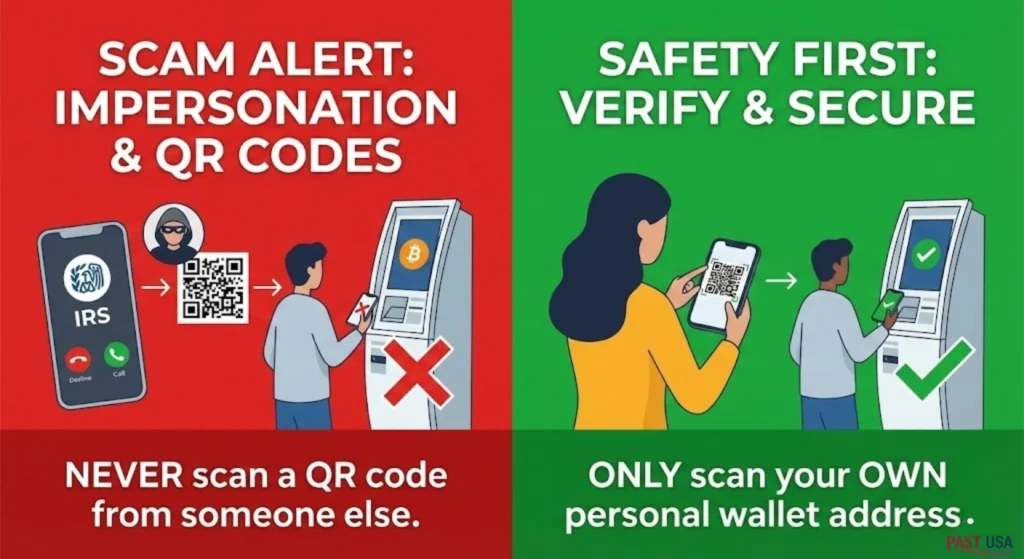
- The Call: You receive a call from someone claiming to be the IRS, Social Security Administration, or “Tech Support” (Microsoft/Amazon).
- The Threat: They claim your identity has been stolen, your bank account is frozen, or you owe back taxes. You are told you must move your money to a “safe government wallet” immediately to protect it.
- The ATM: The scammer stays on the phone with you, directing you to withdraw cash from your bank and go to a specific Bitcoin ATM.
- The Scan: They send you a QR code to scan at the machine. They tell you this is “your” secure locker. In reality, it is the scammer’s wallet.
- The Loss: Once you insert the cash and hit send, the money is gone forever. Blockchain transactions cannot be reversed.
How to Stay Safe
- Legitimate businesses and the government will NEVER ask you to pay via Bitcoin. If the IRS calls you and mentions a Crypto ATM, hang up. It is a scam.
- Never scan a QR code sent to you by someone else. Only scan a QR code from your own personal wallet app.
- Be skeptical of romance. If an online love interest asks you to send them money via a kiosk to help with a “medical emergency” or “plane ticket,” it is a scam.
New legislation in states like California, Arizona, and Alabama is currently being enacted to force Bitcoin ATM operators to place giant warning stickers on machines and limit daily transaction amounts for seniors to curb this epidemic of fraud.
The Regulatory Landscape in the USA
The “Wild West” days of the early 2010s are over. If you are searching for a Crypto ATM thinking it is a way to launder money or evade taxes, think again.
In the United States, Crypto ATM operators are classified as Money Services Businesses (MSB) and are regulated by FinCEN (Financial Crimes Enforcement Network).
KYC (Know Your Customer)
In 2025 and 2026, compliance has tightened.
- SMS Verification: Almost universal. Prevents burner phones from being used easily.
- ID Scanning: Many states now require a driver’s license scan for any transaction over $250 or $1,000.
- Sanctions Screening: Your wallet address may be automatically checked against “blacklists” of known terrorist or criminal wallets. If you try to send money to a dark-web market address, the machine may reject the transaction and flag your ID.
This regulatory tightening is a double-edged sword. It reduces the utility of the machines for privacy advocates, but it legitimizes the industry, allowing it to expand into major retail chains without being shut down by the government.
Bitcoin ATM vs Online Exchanges: Which is Better?
When should you use a kiosk, and when should you stick to an app?
| Feature | Crypto ATM | Online Exchange (Coinbase/Kraken) |
| Fees | High (10-20%) | Low (0.5% – 2%) |
| Payment Method | Cash Bank | Bank Transfer / Debit Card |
| Privacy | Moderate (Phone/ID required) | Low (Full SSN/Bank link required |
| Convenience | Physical Travel Required | From Home |
| Best For | Unbanked users, small cash amounts | Large investments, frequent trading |
If you are looking to invest $10,000 for the long haul, an online exchange is vastly superior due to the lower fees. If you have $50 in your pocket and want to buy Bitcoin right now while you are getting gas, the Bitcoin ATM is the superior choice.
Finding a Machine: The “Bitcoin ATM Near Me” Phenomenon
The infrastructure for these machines has exploded. There are currently over 39,000 Bitcoin ATM locations globally, with the vast majority located in North America.
Where are they usually located?
- Gas Stations: The most common location due to 24/7 access and security cameras.
- Convenience Stores: 7-Eleven, Circle K, and independent bodegas often host them.
- Grocery Stores: Coinstar (the coin counting machines) has partnered with Coinme to turn their kiosks into Bitcoin purchase points.
- Shopping Malls: Simon Malls and other large operators have begun installing them in high-traffic corridors.
To find one, the industry standard resource is Coin ATM Radar. This website and app allow you to filter by coin type (do you need ETH or BTC?), transaction type (buy or sell), and fees. It is highly recommended to check the specific machine’s status online before driving to it, as these machines can occasionally go offline or run out of cash.
Future Trends: What 2026 Holds for the Crypto ATM
As we look toward the remainder of 2026, several trends are shaping the future of the Crypto ATM industry.
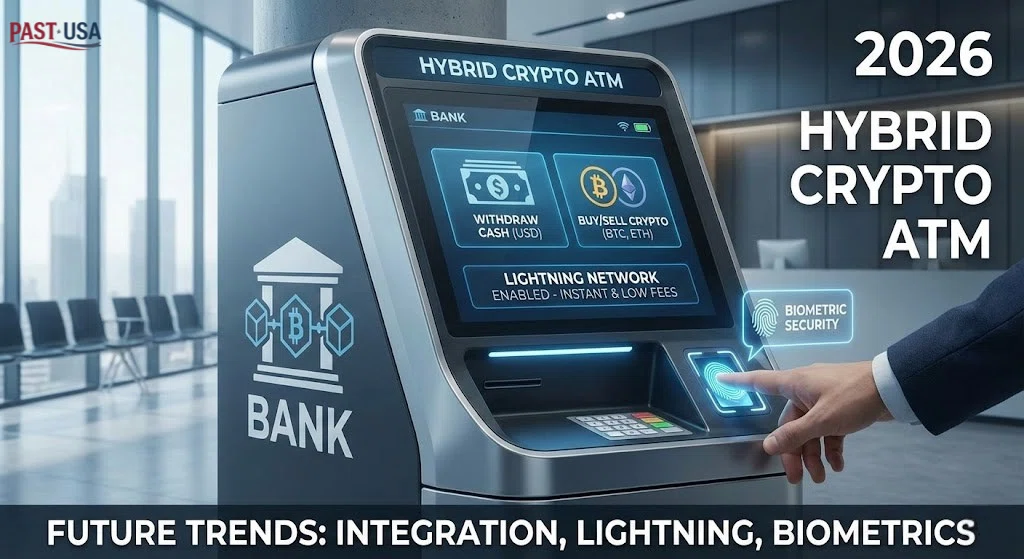
Integration with Traditional Banking
We are seeing the early stages of “hybrid” machines. Some traditional bank ATMs are beginning to offer crypto ATMcapabilities. This would allow you to log in with your Wells Fargo or Chase debit card and buy Bitcoin directly from your checking account at the bank branch. This would likely drive fees down significantly.
Lightning Network Integration
One of the biggest complaints about Bitcoin is the network fee (miner fee), which can be high during peak times. Newer Bitcoin Crypto ATM models are integrating the Lightning Network a “Layer 2” solution that makes transactions instant and costs fractions of a penny. This makes buying small amounts (like $20) viable again, whereas previously the network fee might have eaten up half your purchase.
Biometric Security
To combat the fraud mentioned earlier, some operators are testing facial recognition software. The machine would compare the face of the person standing at the kiosk with the ID scanned. While excellent for security, this raises significant privacy concerns for the crypto community.
Conclusion: A Permanent Fixture in Finance
The Crypto ATM has graduated from a novelty item in hacker cafes to a ubiquitous part of the American streetscape. It represents the democratization of finance making complex digital assets accessible to anyone with cash and a smartphone.
However, with great accessibility comes great responsibility. The Bitcoin ATM is a powerful tool for the unbanked and a convenient on-ramp for the casual investor, but it is also a tool that demands vigilance against scams and an understanding of high fee structures.
As the search volume for these machines continues to trend, one thing is clear: the physical and digital economies are merging. Whether you use them or not, the blinking lights of the Crypto ATM at your local corner store are a signal that cryptocurrency is no longer just “internet money” it is real, it is here, and it is accessible to everyone.
Checkout Who Won Elche VS Barcelona.
Frequently Asked Questions (FAQs)
Q. Can I withdraw cash from a Bitcoin ATM?
Usually, no. About 70% of machines are “buy only” (you put cash in to get crypto). You need to find a specific “two-way” machine to withdraw cash.
Q. Do I need an ID to Access Crypto ATM?
YES. To prevent money laundering, almost all machines require a mobile phone number, and most require a scan of your driver’s license for larger amounts.
Q. Why is the price higher than on Google?
Fees. Operators charge a “spread” (markup) to cover rent and security costs. Expect to pay about 10-15% over the market price.
Q. Can I get scammed By Crypto ATM?
Only if you send money to someone else. Never use a machine because a “government agent” or “tech support” on the phone told you to. That is always a scam.
Q. Do I need a bank account?
No. You only need physical cash, a smartphone with a wallet app, and your phone number. No credit card or bank is required.
Pingback: Epstein Files Released 2026: Peter Attia, Trump, & 3 Million New DOJ Documents
Pingback: Chappell Roan Grammys 2026: The Viral Mugler Outfit & Awards Free Recap