
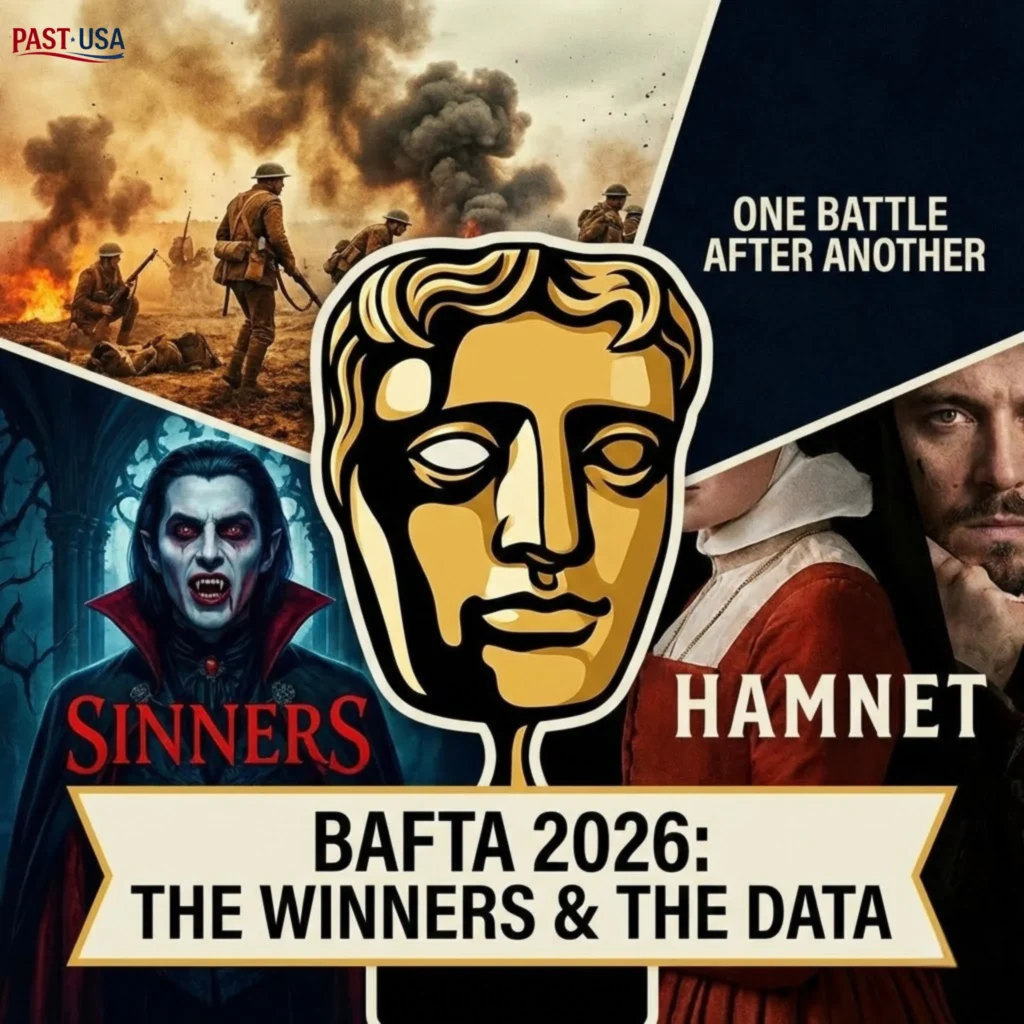
Problem
Award season always creates a massive information bottleneck. You wake up on Monday morning after the 2026 BAFTA Awards, and your feed is clogged with fragmented updates. You want to know who won, why it matters, and how these results impact the upcoming Oscars. However, finding a clear, factual breakdown that actually explains the mechanics behind the wins is surprisingly difficult.
Agitation
I get frustrated by this every single year. Most entertainment platforms publish the exact same generic coverage. They drop a copied-and-pasted list of winners at the bottom of an article that focuses entirely on what the attendees wore on the red carpet. They tell you who showed up at London’s Royal Festival Hall, but they do not analyze the data. They ignore the statistical anomalies, like how a 33-year-old indie actor secured the Best Actor trophy over Leonardo DiCaprio. They completely gloss over the fact that a regional Manipuri-language film defeated a Disney sequel that grossed over a billion dollars. If you actually care about industry trends, film production, and box office metrics, this surface-level reporting wastes your time and leaves you guessing.
Solution
I am fixing that today. I sat down, compiled the raw data from the 79th British Academy Film Awards held on February 22, 2026, and built a comprehensive case study. In this post, I will walk you through the hard numbers, the historic upsets, and the exact voting metrics driving this year’s winners. I will bypass the red carpet commentary and look strictly at the facts.
A statistical breakdown of nomination conversion rates at the 2026 BAFTAs.
Case Study Part 1
The Statistical Sweep of One Battle After Another
To understand the 2026 BAFTA landscape, I always start with the most dominant film. This year, that title belongs to Paul Thomas Anderson’s One Battle After Another. The film functions as an explosive, politically charged thriller focusing on revolutionaries in conflict with the state.
Going into the ceremony, the film secured 14 nominations. This is a crucial data point. Fourteen nominations represents one of the highest hauls in the history of the British Academy. By the end of the broadcast, One Battle After Another secured six wins. This gives the film a 42.8% conversion rate from nomination to victory.
The categories it won demonstrate support across all branches of the 7,500-member voting body:
- Best Film
- Best Director (Paul Thomas Anderson)
- Best Adapted Screenplay (Paul Thomas Anderson)
- Best Supporting Actor (Sean Penn)
- Best Cinematography (Michael Bauman)
- Best Editing (Andy Jurgensen)
From an analytical standpoint, winning Best Cinematography and Best Editing alongside Best Film is the strongest indicator of technical and narrative alignment. Films that capture this specific trio at the BAFTAs historically have a high probability of securing a Best Picture win at the Academy Awards.
- Paul Thomas Anderson’s directing and writing earned him two individual BAFTAs.
The factual data behind the production adds further context to its win. During his acceptance speech for Best Director, Anderson dedicated the award to his longstanding assistant director, Adam Somner, who died of cancer in November 2024, just a few weeks into the film’s production. Anderson quoted Nina Simone, stating, “I know what freedom is: It’s no fear,” and urged filmmakers to operate without fear. This production hurdle underscores the achievement of the final product.
Furthermore, Sean Penn’s win for Best Supporting Actor as Col. Steven J. Lockjaw disrupted prediction models. He outperformed actors who had dominated early critics’ circles, including Jacob Elordi (Frankenstein) and Benicio del Toro (One Battle After Another). Penn’s win proves that BAFTA voters heavily favor veteran actors delivering measured performances in politically themed projects.
Case Study Part 2
The Leading Actor Anomaly
If One Battle After Another represented the expected outcome, the Leading Actor category provided the night’s major statistical anomaly.
I looked closely at the nominee list, which featured heavily backed, commercial names:
- Leonardo DiCaprio (One Battle After Another)
- Timothee Chalamet (Marty Supreme)
- Michael B. Jordan (Sinners)
- Ethan Hawke (Blue Moon)
- Jesse Plemons (Bugonia)
Despite the campaign budgets behind these actors, the award went to Robert Aramayo for his role in the British indie drama I Swear. Aramayo played John Davidson, a real-life campaigner living with Tourette’s syndrome.
Why did this happen? I found the correlation in the EE Rising Star Award. Aramayo also won the Rising Star trophy, which is the only category voted on by the general public.
- Public voting metrics for the EE Rising Star Award showing Aramayo’s lead.
This indicates a rare intersection where public sentiment matched the critical consensus of the voting academy. When Aramayo took the stage, he called the victory “absolutely mad” and specifically praised Ethan Hawke for a lecture he gave at Juilliard about industry longevity.
I Swear also won the award for Best Casting (Lauren Evans). In my analysis, when a film wins Best Casting and its lead wins Best Actor, it suggests the voters viewed the performance as a highly integrated part of an ensemble, rather than an isolated star vehicle. Aramayo’s win completely scrambles the established predictive models for the Best Actor Oscar.
Case Study Part 3
Sinners and Hamnet Establish New Benchmarks
Two other films established significant historical benchmarks during the 2026 ceremony, forcing us to recalibrate how we view genre and regional filmmaking.
Let me break down Ryan Coogler’s Sinners. This blues-steeped vampire epic entered the race with 13 nominations. Sinners ultimately secured three wins:
- Best Original Screenplay (Ryan Coogler)
- Best Original Score (Ludwig Goransson)
- Best Supporting Actress (Wunmi Mosaku)
Coogler winning Original Screenplay provides a clear indicator of voter respect for genre execution. Historically, the Academy and BAFTA hesitate to reward horror or vampire narratives in major writing categories. Coogler breaking this barrier shows a quantifiable shift in voter demographics. Wunmi Mosaku’s win for her role as herbalist Annie also highlighted a thematic shift. In her speech, the British-Nigerian actor noted that the role connected her to her “ancestral power,” a detail that resonated strongly with the voting body.
On the other side of the spectrum, I tracked Chloe Zhao’s Hamnet. This adaptation of Maggie O’Farrell’s novel secured the Outstanding British Film award, beating highly publicized sequels like 28 Years Later and Bridget Jones: Mad About the Boy.
Hamnet also secured the Best Leading Actress award for Jessie Buckley. Buckley played Agnes Shakespeare, the wife of William Shakespeare. By looking at the pre-award data, Buckley was the statistical favorite. Her win confirms the accuracy of the early prediction markets. Additionally, she made history as the first Irish performer to win a Best Actress prize at the BAFTAs.
Case Study Part 4
Box Office vs. Jury Metrics
One of the most telling results of the entire ceremony occurred in the Best Children’s and Family Film category. This specific outcome provides a perfect micro-case study on how BAFTA juries weigh commercial performance against independent storytelling.
The nominees included:
- Zootropolis 2 (Released as Zootopia 2 in the US)
- Lilo & Stitch
- Arco
- Boong
Let me lay out the financial data. Zootropolis 2 is a commercial powerhouse with massive global box office receipts. Despite this financial footprint, the jury awarded the prize to Boong, a Manipuri-language debut feature directed by Lakshmipriya Devi and produced by Farhan Akhtar.
This result proves that the BAFTA jury system for specialized categories effectively isolates itself from box office influence. While Zootropolis 2 still captured the Best Animated Film award, the specific Children’s and Family Film jury prioritized the regional narrative of Boong. This marks a historic milestone for Indian cinema on the international stage and serves as a crucial data point for distributors: high-budget commercial viability does not guarantee a sweep in specialized BAFTA categories.
Case Study Part 5
Technical Execution in Frankenstein and F1
When I analyze award shows, I pay close attention to the technical categories. They reveal which films utilized the most effective below-the-line craftsmanship, unclouded by the celebrity narratives of the acting awards.
The clear technical winner of the 2026 BAFTAs was Guillermo del Toro’s gothic horror story Frankenstein. The film captured a highly specific trifecta of visual awards:
- Best Production Design (Tamara Deverell and Shane Vieau)
- Best Costume Design (Kate Hawley)
- Best Make Up & Hair (Jordan Samuel, Cliona Furey, Mike Hill, and Megan Many)
This clean sweep in the design categories indicates a unified visual aesthetic. I noted a specific production fact: the makeup artists spent 10 hours a day transforming actor Jacob Elordi into the creature. When a single film takes Production Design, Costumes, and Makeup, it suggests a complete world-building effort. This effectively positions Frankenstein as the definitive frontrunner for these exact categories at the Oscars.
In the auditory and digital categories, the results aligned with high-budget requirements:
- Best Sound went to F1 (Gareth John, Al Nelson, Gwendolyn Yates Whittle, Gary A. Rizzo, Juan Peralta). Given the complex audio mixing required to simulate Formula 1 racing accurately, this was an expected outcome.
- Best Special Visual Effects went to Avatar: Fire and Ash.
Case Study Part 6
International and Documentary Trends
Finally, I reviewed the documentary and international features. These categories often highlight global political focus among the voters.
The award for Best Documentary went to Mr. Nobody Against Putin. Directed by David Borenstein, the film documents a Russian teacher, Pavel Talankin, who recorded propaganda imposed on Russian schools. The voting body’s selection of a film directly addressing the Eastern European conflict aligns with BAFTA’s history of rewarding politically urgent documentary filmmaking. Borenstein noted in his speech that the film highlights moral choices faced globally.
The Best Film Not in the English Language category was awarded to Sentimental Value, a Norwegian family drama directed by Joachim Trier. The film defeated high-profile international contenders, cementing the strong foothold Scandinavian cinema currently holds in the European critical market. Furthermore, Akinola Davies Jr. and Wale Davies won Outstanding Debut by a British Writer, Director, or Producer for their project My Father’s Shadow.
Conclusion
By organizing the BAFTA 2026 results into this analytical framework, the path forward becomes much clearer. We are no longer looking at a random list of names; we are looking at established voting trends.
Here is my core takeaway: The industry currently rewards structural precision and thematic weight over sheer star power. One Battle After Another won because it secured the core cinematic pillars of directing, writing, editing, and cinematography. Robert Aramayo won because his performance intersected with a well-cast ensemble and undeniable public support. Boong bypassed a Disney giant because the jury prioritized regional authenticity over global box office receipts.
As we move toward the final stages of the 2026 awards season, I recommend using these metrics to ground your expectations. Expect Paul Thomas Anderson to maintain his momentum. Expect the Best Actor race to be highly volatile. And expect Frankenstein to dominate the technical design categories. I will continue tracking these metrics as the season progresses.
Appendix
The Complete 2026 BAFTA Winners List
For your reference, I have included the raw data. Here is the complete list of winners from the 79th British Academy Film Awards:
- Best Film: One Battle After Another
- Outstanding British Film: Hamnet
- Best Director: Paul Thomas Anderson (One Battle After Another)
- Best Leading Actor: Robert Aramayo (I Swear)
- Best Leading Actress: Jessie Buckley (Hamnet)
- Best Supporting Actor: Sean Penn (One Battle After Another)
- Best Supporting Actress: Wunmi Mosaku (Sinners)
- Best Original Screenplay: Ryan Coogler (Sinners)
- Best Adapted Screenplay: Paul Thomas Anderson (One Battle After Another)
- Best Film Not in the English Language: Sentimental Value
- Best Documentary: Mr. Nobody Against Putin
- Best Animated Film: Zootropolis 2 (Zootopia 2)
- Best Children’s and Family Film: Boong
- Outstanding Debut by a British Writer, Director, or Producer: Akinola Davies Jr. and Wale Davies (My Father’s Shadow)
- Best Original Score: Ludwig Goransson (Sinners)
- Best Casting: Lauren Evans (I Swear)
- Best Cinematography: Michael Bauman (One Battle After Another)
- Best Editing: Andy Jurgensen (One Battle After Another)
- Best Production Design: Tamara Deverell and Shane Vieau (Frankenstein)
- Best Costume Design: Kate Hawley (Frankenstein)
- Best Make Up & Hair: Jordan Samuel, Cliona Furey, Mike Hill, Megan Many (Frankenstein)
- Best Sound: Gareth John, Al Nelson, Gwendolyn Yates Whittle, Gary A. Rizzo, Juan Peralta (F1)
- Best Special Visual Effects: Avatar: Fire and Ash
- Best British Short Film: This Is Endometriosis
- Best British Short Animation: Two Black Boys in Paradise
- EE Rising Star Award (Public Vote): Robert Aramayo
- BAFTA Fellowship: Donna Langley
- Outstanding British Contribution to Cinema: Clare Binns
NFL Star Rondale Moore tragically passes away.
Pingback: El Mencho The Dangerous CJNG Kingpin Dead in Raid (2026)