
In conclusion, the DK11 Game stands out as a significant contender in the mobile gaming landscape of Pakistan. It merges the excitement of a premium casino experience with the ease of a mobile application.
For those who are strategic gamers or social influencers leveraging their referral networks, the DK11 Game offers a genuine opportunity to generate considerable income. The addition of local payment methods eliminates a key obstacle for users in Pakistan, ensuring a seamless financial process.
However, achieving success is not guaranteed. It requires discipline, patience, and a thorough understanding of the associated risks. If you decide to download the DK11 Game, treat it primarily as a form of paid entertainment, with the potential for earning money as a secondary consideration. Play smartly, utilize bonuses effectively, and always bet only what you can afford to lose.
Early Life and Agricultural Roots
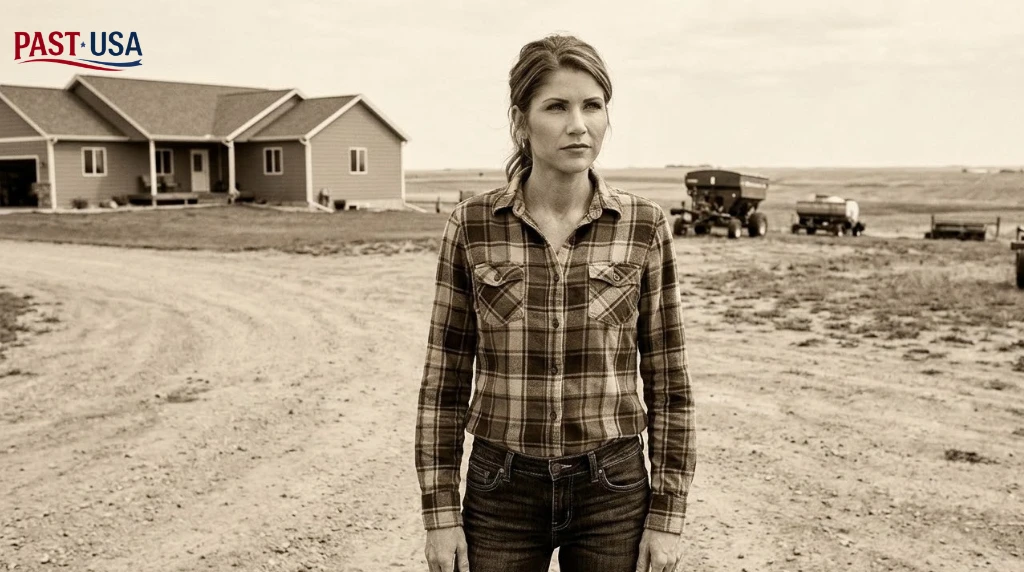
Understanding her political motivations requires looking closely at her formative years in the American Midwest, where the harsh realities of agriculture shaped her perspective on government and economics.
Growing Up on a South Dakota Farm
Born on November 30, 1971, in Watertown, South Dakota, she grew up alongside her siblings on a vast family ranch and farm located in rural Hamlin County. Being raised in such an agricultural setting fostered a robust work ethic in her and gave her a deep insight into the difficulties encountered by American farmers and ranchers. Life on the Plains demanded resilience, early mornings, and a strong bond with the land. After graduating from Hamlin High School, she pursued her studies at Northern State University, aiming to earn a conventional four-year degree.
Taking the Reins
Tragedy struck the family in 1994 when her father, Arnold, was killed in a devastating farm machinery accident. At just 22 years old, she left college to take over the management of the family’s agricultural operations. Under her leadership, the family expanded their enterprise by opening a hunting lodge and a restaurant.
This abrupt change compelled her to maneuver through intricate federal regulations, environmental bureaucracy, and the unpredictable economics of the agricultural industry. The significant financial strain of the federal estate tax, often labeled the “death tax” by conservatives, on her family’s estate after her father’s death profoundly impacted her fundamental political beliefs. Kristi Noem’s perspective was significantly molded by these events, sparking a strong commitment to tax reform and minimal government interference that transformed a rural farmer into a passionate political advocate. Ultimately, she achieved her higher education through online courses, obtaining a Bachelor of Arts degree in political science from South Dakota State University in 2012.
The Beginning of a Political Career
Her leap from agricultural management to public office was swift, marked by a rapid ascent through the ranks of the Republican Party.
State Legislature Success
Her political career officially began in 2006 when she won a seat in the South Dakota House of Representatives, representing the 3rd district. During her time in the state legislature, she quickly gained a reputation as an articulate and staunch conservative, advocating for lower taxes, reduced government spending, and the uncompromising protection of Second Amendment rights. Her leadership skills did not go unnoticed, and she was eventually elected Assistant Majority Leader by her Republican peers.
Moving to Washington: U.S. House of Representatives
In 2010, amid the nationwide “Tea Party” wave that swept conservative populists into office, she sought the Republican nomination for South Dakota’s at-large congressional district. She successfully defeated the incumbent Democratic representative in a closely contested race. Upon arriving in Washington, D.C., Kristi Noem was immediately recognized as a rising star within the Republican Party. She was elected as one of the two freshman class liaisons to the House Republican leadership, granting her unprecedented early access to the inner workings of congressional power.
During her four terms in the U.S. House of Representatives, she built a substantial legislative record:
- Committee Leadership: She served on prominent committees, including the House Agriculture Committee, the Armed Services Committee, and the powerful House Ways and Means Committee.
- The 2014 Farm Bill: She played a significant role in negotiating this critical legislation, ensuring that the interests of South Dakota’s agricultural producers and ranchers were protected against overregulation.
- Tax Cuts and Jobs Act of 2017: She successfully advocated for the doubling of the estate tax exemption a deeply personal legislative victory given her family’s history with the tax.
After serving her state in Washington, Kristi Noem set her sights on the highest executive office in her home state, launching a campaign for governor in the 2018 election cycle.
Making History as South Dakota Governor
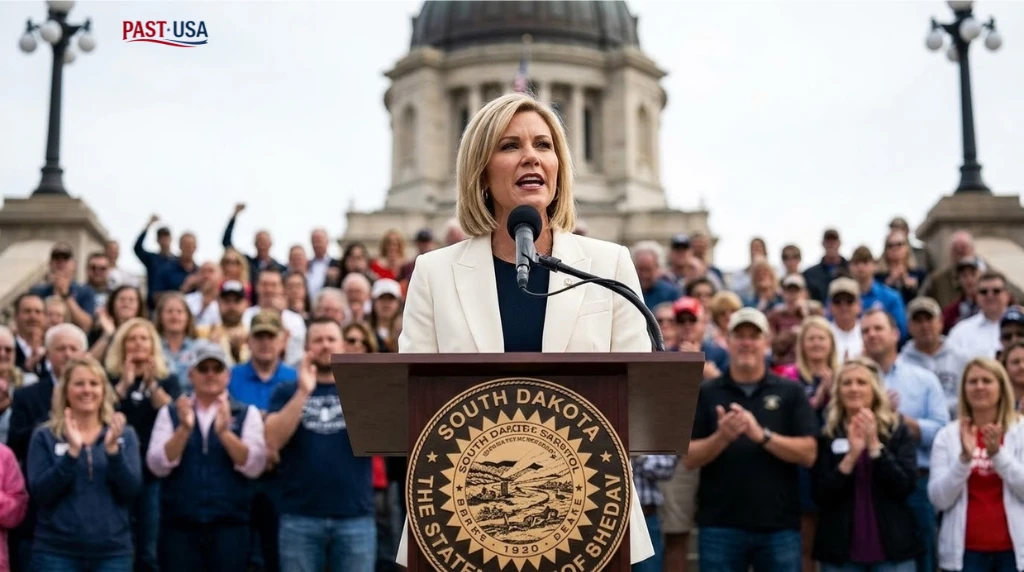
Her transition to the executive branch brought her national attention, particularly as she navigated unprecedented global crises with a distinctively hands-off conservative approach.
First Term and the COVID-19 Pandemic
In 2018, she defeated her Democratic opponent in a highly competitive race to become South Dakota’s 33rd governor, making history as the first woman to hold the office. For Kristi Noem, the governorship was an opportunity to push to streamline state government, expand broadband access to isolated rural communities, and aggressively promote South Dakota as a business-friendly, low-tax haven free from heavy regulatory burdens.
It was the global events of 2020 that truly catapulted her to national prominence. During the COVID-19 pandemic, Kristi Noem gained a massive national following among conservatives for her distinctive approach to public health.
Key elements of her pandemic response included:
- No Statewide Lockdowns: Unlike the vast majority of U.S. governors, she resolutely refused to issue statewide stay-at-home orders or forced business closures.
- No Mask Mandates: She emphasized personal responsibility over government mandates, arguing that it was up to free individuals and businesses to make the best decisions for their health.
- High-Visibility Events: She supported and hosted large-scale events, such as the Sturgis Motorcycle Rally and a controversial July 4th fireworks celebration at Mount Rushmore.
While public health officials strongly criticized her approach pointing to periods when South Dakota experienced high per-capita infection and mortality rates her unyielding stance made her a hero to the political right.
Re-election and Economic Policies
The leadership style of Kristi Noem proved incredibly popular with her constituents. She successfully leveraged her rising profile to benefit her state’s economy, heavily advertising South Dakota’s lack of restrictions to attract new residents, tourists, and corporate investments. By highlighting the state’s lack of a corporate or personal income tax, she drew businesses fleeing highly regulated coastal states. In 2022, she comfortably won re-election with a historic margin, validating her leadership style in the eyes of her constituents and keeping her name in the conversation for higher national office.
The 2024 Election Cycle and the Memoir Controversy
With a strong executive record and a massive national following, she entered the 2024 political arena as a major player, though she soon faced severe, self-inflicted public relations challenges.
Vice Presidential Speculation
As the 2024 presidential election cycle ramped up, Kristi Noem was widely considered a top-tier contender to be Donald Trump’s vice-presidential running mate. She campaigned vigorously for the Republican ticket, utilizing her executive experience and strong base of support among rural, working-class conservative voters to boost the campaign’s momentum across the Midwest. Her appearances on the campaign trail were marked by fiery speeches championing “America First” policies and traditional conservative values.
The “No Going Back” Dog Controversy
The political momentum of Kristi Noem faced a significant hurdle with the release of her 2024 memoir, No Going Back. In the book, she recounted a story from decades prior about shooting a 14-month-old wirehaired pointer named Cricket. She described the dog as an “untrainable” working animal that had ruined a hunt and aggressively killed a neighbor’s chickens. In the same chapter, she also recounted euthanizing a smelly, aggressive goat in a gravel pit.
The anecdote, intended to demonstrate her willingness to take responsibility for difficult and unpopular decisions, backfired spectacularly. The story drew intense, universal condemnation from:
- Animal Rights Activists: Who viewed the act as cruel and unnecessary.
- Political Commentators: Across both sides of the aisle, who questioned the political calculus of including the story.
- The General Public: Sparking a massive social media backlash and widespread outrage.
While the overwhelming controversy ultimately derailed her chances of becoming the vice-presidential nominee, it did not entirely sever her political alliance with Donald Trump, who valued her unwavering loyalty on the campaign trail.
Ascension to the Presidential Cabinet
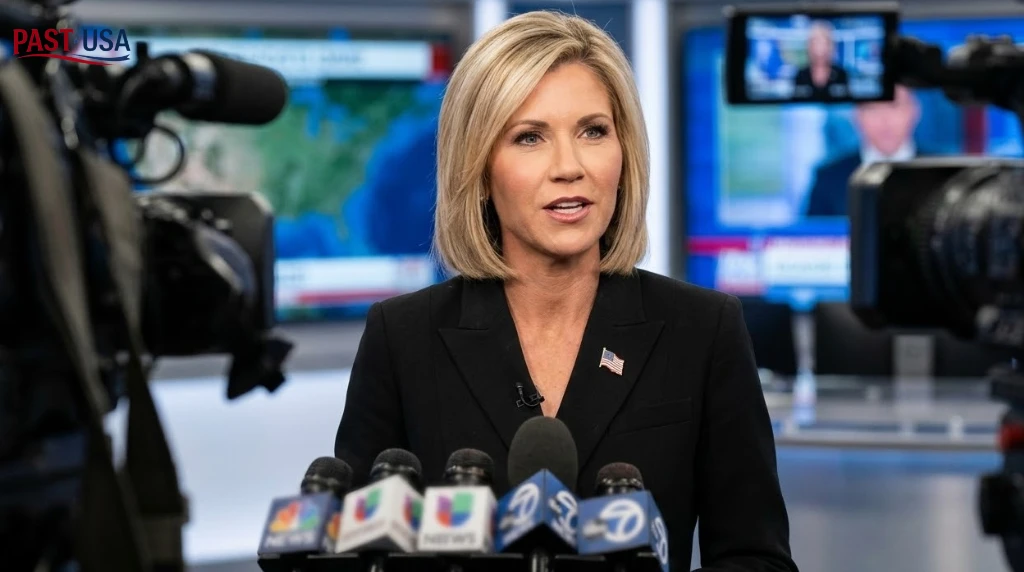
Despite the fallout from her memoir, her loyalty to the administration was rewarded with one of the most powerful and demanding roles in the federal government.
Nomination as Secretary of Homeland Security
Following his election victory in November 2024, the incoming president nominated Kristi Noem to serve in his cabinet, offering her a chance at a highly influential federal role. She was nominated to lead the Department of Homeland Security (DHS), the third-largest federal department in the United States government. The DHS boasts a sprawling workforce of approximately 260,000 employees and a massive operational budget designed to protect the nation from a multitude of domestic and international threats.
The confirmation process in the Senate was highly contentious, with Democrats grilling her on her lack of traditional law enforcement experience and revisiting the controversies from her gubernatorial tenure. Nevertheless, on January 25, 2025, the United States Senate confirmed her appointment.
Early Days at DHS and Border Policies
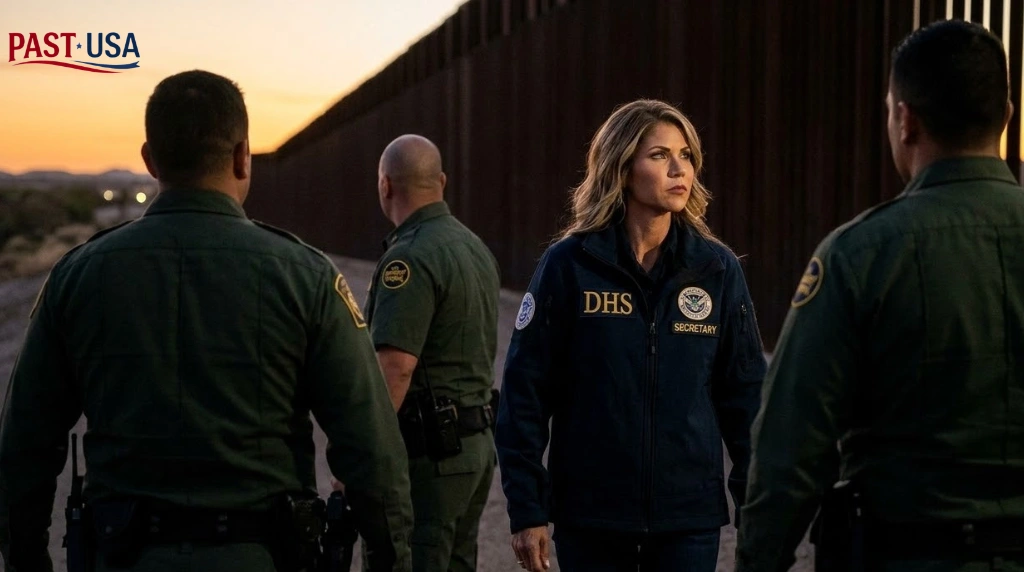
Taking the helm at DHS meant Kristi Noem was now overseeing a vast array of critical domestic agencies, including Customs and Border Protection (CBP), Immigration and Customs Enforcement (ICE), the Federal Emergency Management Agency (FEMA), the Transportation Security Administration (TSA), the Coast Guard, and the Secret Service.
She quickly became the public face of the president’s promise to execute mass deportations and fundamentally seal the U.S.-Mexico border. Her initial actions included:
- Aggressive Enforcement: Accompanying federal agents on immigration raids, often appearing in tactical gear for promotional materials to project a tough-on-crime image.
- Rapid Deportations: Prioritizing the removal of undocumented immigrants, particularly those with criminal records or suspected gang affiliations.
- Border Wall Construction: Resuming and expanding physical barriers along the southern border.
Supporters praised her for restoring the rule of law, noting that under the leadership of Kristi Noem, the DHS reported record-low border crossings and successfully removed hundreds of thousands of individuals. She proudly declared to the press that the border was the most secure it had been in American history.
A Tumultuous Tenure: Crises and Controversies
The perceived successes at the border, however, were soon overshadowed by bureaucratic mismanagement, public outcry, and severe internal dysfunction.
FEMA Mismanagement Allegations
However, the tenure of Kristi Noem at the Department of Homeland Security was severely marred by her management of the nation’s disaster response apparatus through FEMA. Her leadership drew severe, sustained criticism from emergency management professionals.
Reports indicated that she attempted to heavily micromanage the agency, requiring her personal approval for all operational spending over $100,000. This bottleneck reportedly delayed critical disaster relief deployments during severe flooding in Texas and other extreme weather events throughout 2025. Anonymous FEMA staffers and former Obama-era officials publicly complained that her stringent ideology and desire to artificially shrink the agency’s footprint were making the United States far more vulnerable to natural disasters.
The Minneapolis Incident and Public Backlash
The administration’s policies, which heavily prioritized rapid deportations over lengthy judicial reviews, led to highly publicized clashes in major metropolitan areas, particularly sanctuary cities. Tensions reached an absolute boiling point in early 2026 following heavily militarized operations in Minneapolis, where federal immigration agents fatally shot two U.S. citizens, Renee Good and Alex Pretti, who were participating in anti-ICE protests.
The situation escalated dramatically when Kristi Noem publicly characterized the deceased individuals as “domestic terrorists,” a claim that was fiercely disputed by local mayors, civil rights organizations, and community leaders given the victims’ participation in a civil protest. Democrats and immigration advocates immediately called for her resignation, labeling her policies as draconian, reckless, and unconstitutional.
Congressional Hearings and Internal Friction
The political pressure mounted exponentially in early March 2026 when she appeared before the Senate and House Judiciary Committees for routine oversight hearings. During these highly contentious sessions, Republican lawmakers also openly challenged Kristi Noem.
- Senator Thom Tillis: Threatened to indefinitely block DHS nominees over her handling of internal investigations and her refusal to answer questions directly.
- Senator John Kennedy: Aggressively questioned her regarding a $220 million taxpayer-funded advertising campaign that featured her prominently, suggesting it was an inappropriate use of government funds for blatant self-promotion.
- Internal Turmoil: Damaging media reports from prominent news outlets surfaced alleging deep internal turmoil within the department, highlighting a toxic work environment, the administration of polygraph tests to staff, and a controversial personal relationship with a senior political advisor, Corey Lewandowski.
The Shocking Dismissal and Reassignment
The cumulative weight of the bipartisan congressional hostility, the FEMA mismanagement allegations, and the explosive fallout from the Minneapolis incident proved insurmountable.
Firing from DHS in March 2026
On March 5, 2026, President Donald Trump officially announced that he was replacing Kristi Noem as Secretary of Homeland Security. She became the first cabinet secretary to be fired during Trump’s second term, marking a shocking and abrupt end to a highly publicized tenure. The President announced that Senator Markwayne Mullin of Oklahoma had been nominated to succeed her, taking over the sprawling security apparatus she had sought to reform.
The New Role: Special Envoy for the Shield of the Americas
Despite the highly public dismissal from her powerful cabinet post, she was not entirely exiled from the administration. In the exact same announcement, the President revealed that Kristi Noem would be transitioning into a newly created diplomatic and security role: Special Envoy for The Shield of the Americas.
While commentators vigorously debated whether this reassignment was a humiliating demotion designed to save face or a strategic pivot, she publicly embraced the new position. As Special Envoy, her new responsibilities include:
- Hemispheric Security: Focusing heavily on the Western Hemisphere’s collective security and border integrity.
- International Alliances: Managing diplomatic relationships with nations in Latin America and the Caribbean.
- Counter-Narcotics: Coordinating international operations with the State Department and the Department of Defense to dismantle transnational cartels responsible for trafficking lethal narcotics like fentanyl into the United States.
In her public statements on social media following the transition, Kristi Noem expressed profound gratitude to the President for the new opportunity and emphasized the critical nature of the Western Hemisphere to U.S. national security.
The Complex Legacy of a Political Lightning Rod
The political journey of Kristi Noem underscores the chaotic and unpredictable landscape of contemporary American politics. Her evolution from a rural farmer to a divisive figure in the national cabinet has been marked by an unwavering readiness to confront established norms, whether it involved resisting public health directives during a global pandemic or executing some of the most stringent immigration enforcement measures in recent history.
Although her tenure as DHS Secretary was ultimately truncated amid intense controversy, tragedy, and a decline in congressional trust, she significantly altered the national conversation surrounding immigration, executive authority, and the boundaries of federal agency oversight. It remains uncertain whether her new diplomatic position will enable her to effectively restore her political image or signify the end of her public service career. What is clear, however, is that she departs with a multifaceted legacy that mirrors the deeply divided and high-stakes nature of today’s political climate.
Checkout the 2026 Winter Paralympics.