
If you’ve taken a moment to check Google Trends, X (formerly Twitter), or any prominent news ticker in the past day, you’ve probably noticed one phrase taking center stage: the 25th Amendment. It has become the top trending search topic in the United States, igniting a whirlwind of constitutional discussions, political conjecture, and real public concern.
But what’s the reason for this sudden interest? Why is a constitutional amendment that was ratified nearly 60 years ago now at the heart of American political discourse in February 2026?
The explanation can be found in a perfect storm of late-night social media activity, rising geopolitical tensions concerning Greenland, and an increasing number of lawmakers who are openly questioning the President’s ability to lead. As demands for Vice President J.D. Vance and the Cabinet to step in intensify, millions of Americans are urgently seeking to grasp what the 25th Amendment entails and whether it could indeed be invoked to remove a sitting President.
This is your comprehensive guide to the debate, the background, and the stark realities of the Constitution’s most dramatic
Why the “25th Amendment” is Trending Right Now
To understand the it, we have to look at the events of thevpast. The surge in search traffic for the 25th Amendment wasn’t random; it was triggered by a specific series of erratic behaviors that have rattled growing numbers of observers in Washington.
The “Greenland” Incident and the “Peace” Comments
The catalyst appears to be a flurry of statements made by President Trump regarding foreign policy. Specifically, late-night posts on social media where the President declared he “no longer feel[s] an obligation to think purely of peace” have sent shockwaves through diplomatic channels. Coupled with a renewed, confusing push to “acquire” Greenland a proposal many thought was dormant lawmakers are citing these outbursts not just as bad policy, but as evidence of instability.
The Congressional Call to Action
Unlike previous political skirmishes, the reaction this week has shifted from calls for impeachment (which is a political process) to calls for the 25th Amendment (which addresses capability).
- Senator Ed Markey (D-MA) explicitly stated, “Invoke the 25th Amendment,” arguing that the President’s rhetoric is no longer just political maneuvering but a direct threat to national safety.
- Rep. Yassamin Ansari (D-AZ) echoed this, saying, “The 25th Amendment exists for a reason we need to invoke it immediately.”
- Rep. Sydney Kamlager-Dove (D-CA) warned, “He’s risking the safety of every American. Invoke the 25th.”
These aren’t whispers in backrooms; they are public, on-the-record demands from sitting members of Congress, driving the public to search engines to ask: Can they actually do that?

What Is the 25th Amendment?
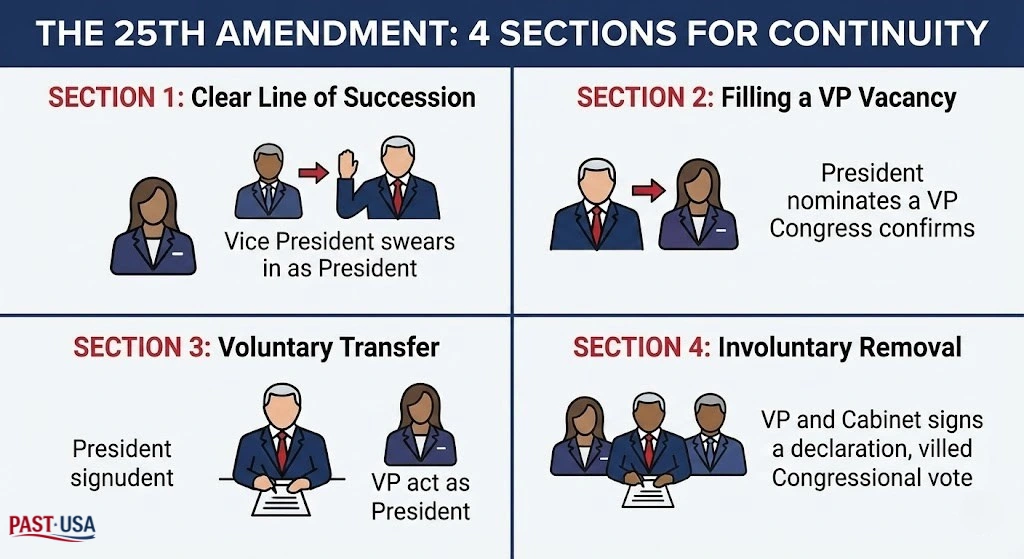
The 25th Amendment to the United States Constitution is often misunderstood as solely a tool for removing a President. In reality, it is a four-part framework designed to ensure the continuity of government. Ratified in 1967 in the wake of the assassination of President John F. Kennedy, its primary goal was to fix the Constitution’s vague language about what happens when a President dies, resigns, or becomes incapacitated.
To understand the current crisis, you must understand the four distinct sections:
Section 1: The Clear Line of Succession
Text: “In case of the removal of the President from office or of his death or resignation, the Vice President shall become President.”
Meaning: This sounds obvious now, but before 1967, it wasn’t clear if the VP actually became President or just “acted” as President. Section 1 clarified that if the President is gone, the VP takes the title and the full power.
Section 2: Filling a Vice Presidential Vacancy
Text: “Whenever there is a vacancy in the office of the Vice President, the President shall nominate a Vice President who shall take office upon confirmation by a majority vote of both Houses of Congress.”
Relevance: This has been used twice (for Gerald Ford and Nelson Rockefeller). It ensures we are never without a Vice President for long a crucial fail-safe if the 25th Amendment is ever fully invoked.
Section 3: Voluntary Transfer of Power (The “Medical” Clause)
How it works: The President sends a written declaration to the Senate and House leaders saying he is “unable to discharge the powers and duties of his office.” The VP becomes Acting President until the President writes back saying he is ready to return.
History: This is the most frequently used section. Presidents Reagan, George W. Bush, and Biden have all invoked Section 3 while undergoing medical procedures (like colonoscopies) requiring anesthesia. It is temporary, voluntary, and non-controversial.
Section 4: Involuntary Removal (The “Coup” Clause)
The Current Focus: This is the section trending today. It deals with a President who is unable or unwilling to step down voluntarily. It is the only constitutional mechanism that allows the Vice President and the Cabinet to strip a President of power against his will.
Why it matters: When people tweet “Invoke the 25th Amendment,” they are specifically talking about Section 4.
The Mechanics of Section 4
The reason the 25th Amendment is trending is that people want to know how removal happens. Is it a vote? A trial? A letter? The process for Section 4 is deliberately difficult to prevent it from being used for political disagreements.
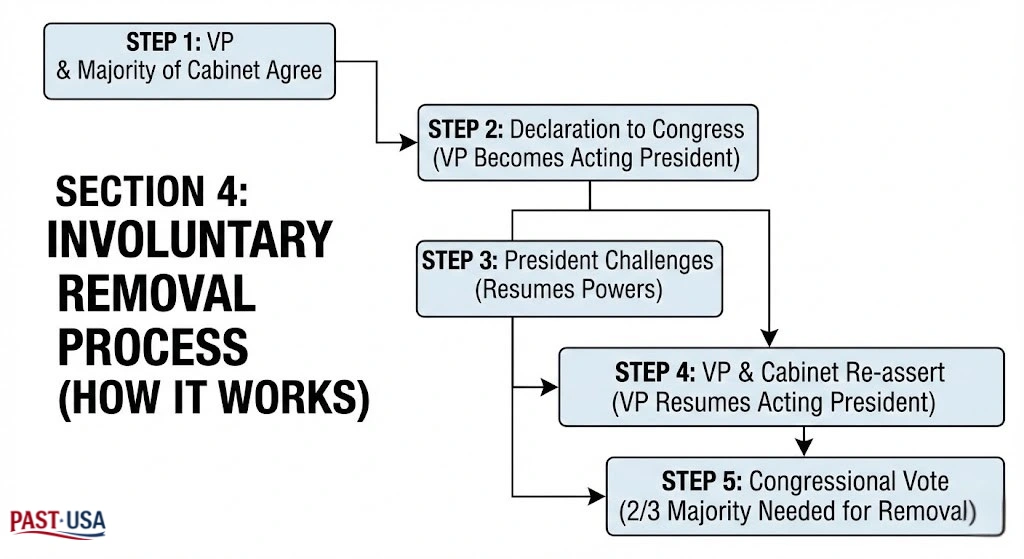
Here is the step-by-step roadmap of what would have to happen in 2026:
Step 1: The Mutiny
Vice President J.D. Vance and a majority of the “principal officers of the executive departments” (the Cabinet) must agree that the President is “unable to discharge the powers and duties of his office.”
Note: It must be the VP and the Cabinet. Congress cannot start this process alone. If the VP refuses to sign on, Section 4 is dead in the water.
Step 2: The Declaration
They send a written declaration to the President pro tempore of the Senate and the Speaker of the House.
Immediate Effect: The moment this letter is delivered, the President is stripped of his authority. Vice President Vance would immediately become “Acting President.”
Step 3: The President Fights Back
The President can send his own written declaration to Congress stating that “no inability exists.”
Immediate Effect: The President resumes his powers unless the VP and Cabinet act again.
Step 4: The Showdown
If the President claims he is fine, the VP and the Cabinet have four days to disagree. If they send a second declaration to Congress within those four days re-asserting that the President is unable to serve, the Vice President keeps the powers, and the issue goes to Congress.
Step 5: The Congressional Vote
Congress must assemble within 48 hours. They then have 21 days to debate and vote.
The Threshold: To permanently remove the President, two-thirds of both the House and the Senate must vote that the President is unable to discharge his duties.
The Outcome: If the vote fails in either chamber, the President regains his powers immediately. If it passes, the VP continues as Acting President.
The “Unitary Executive” and the Constitutional Crisis
Part of the reason the 25th Amendment is such a hot topic in legal circles right now involves the broader battle over the “Unitary Executive” theory.
Recent Supreme Court decisions, including the Seila Law case and others leading up to 2026, have reinforced the idea that the President has total authority over the executive branch. This legal framework makes the 25th Amendment one of the only remaining checks on a President who may be acting erratically but lawfully.
Legal scholars arguing in outlets like SCOTUSblog have noted that the Framers intended for separation of powers to be a safeguard. However, if the Supreme Court insulates the President from Congressional oversight, the internal check of the Cabinet (via the 25th Amendment) becomes the last line of defense. This creates a paradox: The Cabinet members needed to invoke the amendment are the very people the President appointed and can fire (potentially) before they can sign the declaration.
This “race to the trigger” could a President fire his Cabinet fast enough to stop them from invoking the 25th Amendment? is a favorite topic of constitutional law professors and is fueling much of the anxiety in the current news cycle.
The Vice President’s Dilemma
In 2026, all eyes are on the Vice President. The 25th Amendment puts the VP in an excruciating political position.
To invoke Section 4, the Vice President essentially has to lead a mutiny against the person who put them on the ticket. In the current political climate, with the base of the ruling party fiercely loyal to the President, a move by Vice President Vance to invoke the amendment would be viewed by many as a betrayal or a coup.
However, the text of the amendment makes the VP the “key.” Without his signature, the Cabinet cannot act. This centralization of power in the Vice Presidency is unique to the 25th Amendment. It forces the VP to weigh political loyalty against constitutional duty a dramatic tension that is driving millions of clicks to news articles today.

Has Section 4 Ever Been Used?
While the 25th Amendment is trending, it is important to ground the discussion in history.
Section 4 has NEVER been used.
It has been discussed, whispered about, and drafted, but never executed.
- 1987 (Reagan): Incoming aides to White House Chief of Staff Howard Baker debated invoking Section 4 due to President Reagan’s perceived inattention and the fallout of the Iran-Contra affair. They decided against it after observing Reagan closely.
- 2021 (Trump): Following the events of January 6, there were widespread reports that Cabinet members and Vice President Mike Pence discussed the 25th Amendment. However, it was never formally invoked, largely because the term was ending in two weeks.
The fact that it has never been used adds to the intrigue. If it were happened in 2026, it would be uncharted territory for the American Republic. We would be witnessing the first-ever involuntary transfer of power between a living President and Vice President.
5 Reasons Why the 25th Amendment is Harder to Use Than You Think
Despite the trend, the reality of invoking the 25th Amendment is incredibly difficult. Here is why many political analysts are skeptical it will happen, even with the current fervor:
- The “Majority” Problem: You need the VP plus half of the Cabinet. These are 15 department heads (State, Treasury, Defense, etc.). Getting 8 of them to agree to remove their boss is a massive political hurdle.
- The “Acting” Status: Even if successful, the President isn’t technically “fired.” The VP just becomes “Acting President.” The President retains the title and residence, creating a confusing dual-presidency dynamic.
- The Time Limit: The President can challenge it immediately. This forces Congress to vote quickly.
- The Supermajority: Getting 2/3 of the House AND the Senate to agree on anything is rare. Getting them to agree to remove a President of their own party (assuming the President’s party holds some power) is statistically improbable.
- The “Cabinet” Definition: The President can fire Cabinet members. If he gets wind of a 25th Amendment plot, he could theoretically fire the conspirators and appoint “Acting” secretaries who are loyal to him, muddying the legal waters of who gets to vote.
FAQs
Q: Can the 25th Amendment be used for “poor judgment”?
Legally, the text just says “unable to discharge powers.” It doesn’t define “unable.” However, the amendment’s framers intended it for medical or mental incapacity, not just bad policy or political disagreement.
Q: Does the President get a lawyer?
The 25th Amendment doesn’t specify a trial like impeachment. It is a political determination made by the Cabinet and Congress. However, the President would certainly have legal counsel challenging every step.
Q: What happens if the VP refuses?
Then the 25th Amendment (Section 4) cannot be used. The Constitution allows Congress to create an “other body” to replace the Cabinet in the process, but the VP is indispensable.
Is the 25th Amendment a coup?
No. It is a constitutional process ratified by the states. A coup is an illegal seizure of power. The 25th Amendment is the legal transfer of power.
Q: Who becomes VP if the VP becomes Acting President?
No one. The VP remains Vice President but acts as President. The VP office doesn’t become vacant, so no new VP is appointed unless the President is permanently removed or dies.
Conclusion
As we observe the term “25th Amendment” gaining traction worldwide on this February day in 2026, we find ourselves in a nation wrestling with the profound constitutional “what if.”
While the current discourse from Democratic lawmakers and the noticeable unease on social media indicate a potential crisis, the historical and structural hurdles to activating Section 4 are still significantly high. The 25th Amendment was intended to serve as a break glass in case of emergency mechanism, not a routine political tool.
Nevertheless, the mere fact that it is trending and that millions of Americans are delving into the details of Section 4 reflects a change in the national sentiment. Whether this leads to a groundbreaking constitutional action or simply fades into another wave of political outrage is yet to be determined. For now, the 25th Amendment has transformed from a neglected section of the Constitution into the most discussed issue in America.