
If you have scrolled through your social media feeds or glanced at Google Trends in the last 24 hours, you’ve likely been greeted by something anomalous. Amidst the usual political discourse and celebrity gossip, a ghostly, beautiful cosmic apparition has captured the American zeitgeist. It looks impossibly organic a concentric series of glowing ripples surrounding a central, shrouded beam of light. It looks, unmistakably, like a cosmic egg.
You are looking at the Hubble Egg Nebula image, and it is currently the hottest topic in astronomy and digital culture alike.
While space enthusiasts have known about this object for decades, a perfect storm of viral sharing and perhaps a collective need for cosmic perspective has propelled it back into the mainstream spotlight this week. But what exactly are we looking at? Why does a star billions of miles away look like breakfast? And why is an image originally captured years ago breaking the internet in 2026?
This is the definitive, deep-dive guide to the Hubble Egg Nebula image, exploring the awe-inspiring science, the violent beauty of stellar death, and the enduring legacy of the telescope that brought it to humanity.
The Viral Phenomenon: Why the Hubble Egg Nebula Image is Trending in 2026
It is a testament to the enduring power of the Hubble Space Telescope (HST) that its archival data can still stop the world in its tracks. In an era dominated by the newer James Webb Space Telescope’s infrared wonders, Hubble’s visible-light mastery remains unparalleled.
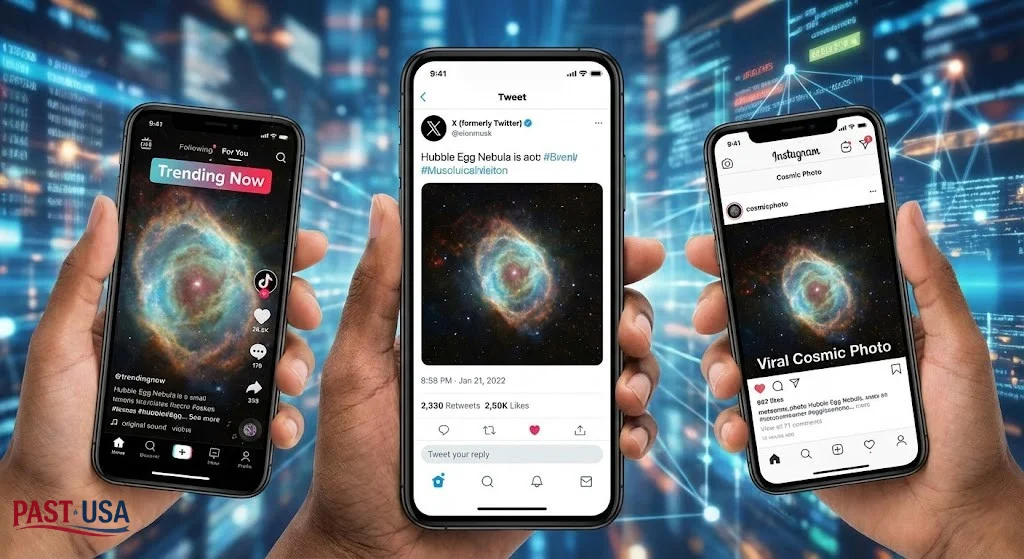
The current explosion of interest in the Hubble Egg Nebula image appears to stem from a “rediscovery” cycle common on platforms like TikTok, X (formerly Twitter), and Instagram. In early February 2026, several prominent astronomy influencers and science communicators began resharing high-resolution, reprocessed versions of the classic Hubble observations (originally taken in the 1990s and early 2000s).
On modern, ultra-high-definition 8K screens, the intricate details of the nebula’s concentric shells pop with unprecedented clarity. The image struck a chord. It is simultaneously alien and familiar, violent yet serene.
The trend highlights a crucial aspect of modern astronomy: the data is timeless. While we build new telescopes, the archives of Hubble contain treasures that, when viewed with fresh eyes or processed with newer software techniques, feel brand new. The viral spread of the Hubble Egg Nebula image this week proves that the public’s appetite for the sublime beauty of our universe is insatiable.
Deconstructing the Visual Masterpiece
To understand why this image is so captivating, we must slowly deconstruct what our eyes are seeing. The Hubble Egg Nebula image is not a snapshot of a tranquil cloud; it is a freeze-frame of a slow-motion celestial explosion.
When you look at the high-resolution image, several distinct features immediately grab your attention, earning it its peculiar nickname.
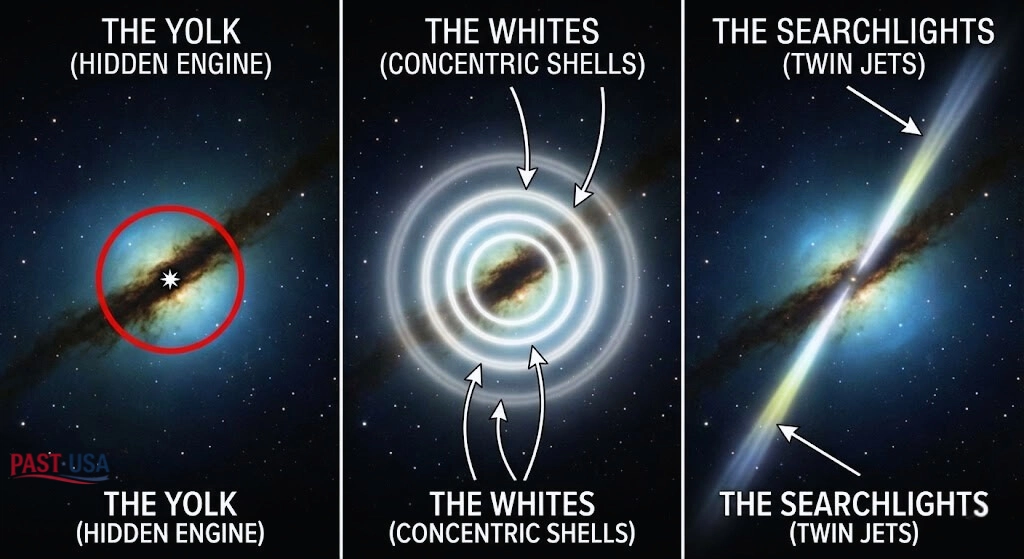
The “Yolk” (The Hidden Engine)
At the very center of the image, where the “yolk” of an egg would be, there is… almost nothing visible. There is a dark, dense band of dust bisecting the object. The star that created this entire structure is hidden deep within this thick cocoon. We cannot see the star directly in visible light because the dust is too opaque. However, we know it’s there because of the havoc it is wreaking on its surroundings. This central star is currently in a violent phase of shedding its outer layers.
The “Whites” (The Concentric Shells)
The most striking feature, and the one that gives the Hubble Egg Nebula image its organic feel, is the series of concentric rings radiating outwards. These look like ripples in a pond after a stone has been thrown in.
These are actually gigantic shells of dust and gas that have been puffed out by the dying star over thousands of years. The astonishing uniform spacing of these rings suggests a rhythmic process. The star isn’t just leaking gas continuously; it is “hiccuping” or pulsing. Astronomers estimate that the star ejects a new shell roughly every few hundred years. Seeing these perfectly spaced rings is like looking at the growth rings of a cosmic tree, chronicling the star’s recent history of instability.
The “Searchlights” (The Twin Jets)
Cutting through the murky surroundings are two brilliant shafts of light, seemingly shooting out from the hidden center towards the top and bottom of the frame.
Imagine a lighthouse trapped inside a dense fog bank. If you punched two holes on opposite sides of the lighthouse structure, beams of intense light would shoot out into the fog, illuminating the mist in straight lines. That is exactly what is happening here. The central star is incredibly bright, but its light is blocked by a flattened torus (doughnut shape) of dust around its equator. However, the dust is thinner at the star’s poles. The intense starlight escapes through these polar openings, acting like massive searchlights illuminating the surrounding concentric gas shells and creating the “twin jet” appearance.
The Hard Science: What Is the Egg Nebula?
While the internet knows it as the Egg Nebula, professional astronomers refer to it by its catalog names: CRL 2688 or the Westbrook Nebula (named after astronomer William E. Westbrook, who tragically died young shortly after its discovery in the 1970s).
It is located approximately 3,000 light-years away from Earth in the constellation Cygnus (The Swan).
To understand the science behind the Hubble Egg Nebula image, we have to understand stellar evolution. This object is a snapshot of a very specific, very brief moment in a star’s life cycle known as a Protoplanetary Nebula (PPN).
The Pre-Ghost Phase
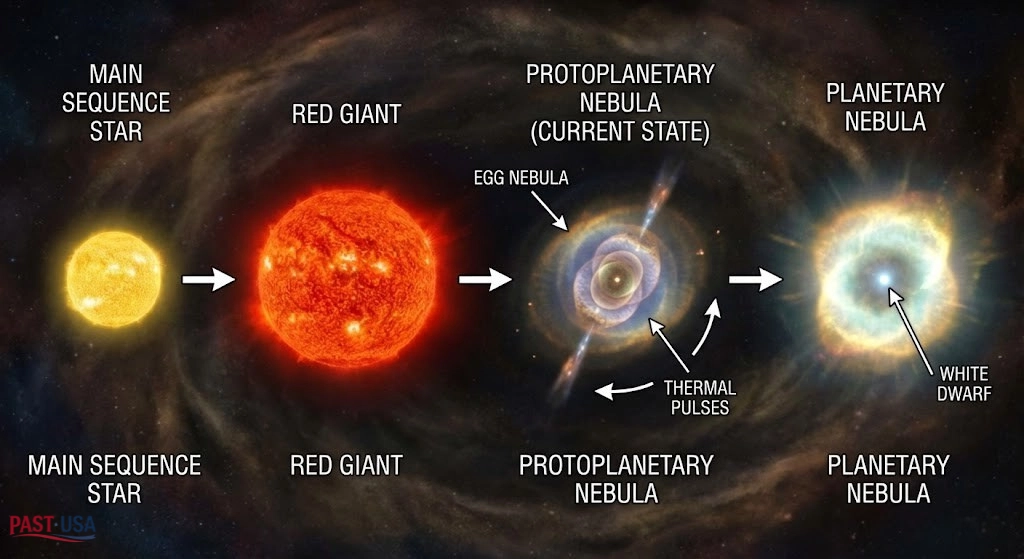
Do not let the name fool you; “protoplanetary” has nothing to do with planets. It’s an unfortunate historical misnomer. A protoplanetary nebula is the awkward transitional phase between a bloated Red Giant star and a beautiful, glowing Planetary Nebula.
Here is the timeline of the star inside the Egg:
- Main Sequence: For billions of years, it was a star much like our Sun, fusing hydrogen into helium.
- Red Giant: It ran out of hydrogen fuel in its core. The core collapsed, got hotter, and the outer layers swelled up massively. It became a Red Giant.
- The “Puffing” Phase (Current State): As a Red Giant, the star became unstable. Deep inside, helium began fusing into carbon in violent bursts. These thermal pulses sent shockwaves upward, literally pushing the star’s outer atmosphere into space. This is what created the concentric shells seen in the Hubble Egg Nebula image.
- The Future (Planetary Nebula): Right now, the ejected gas is only visible because it’s reflecting light from the central star (like dust motes in a sunbeam). Soon–in astronomical terms, perhaps only a few thousand yearsthe central star will shed its last layers, exposing the incredibly hot, tiny core (a White Dwarf). This hot core will blast unlimited amounts of ultraviolet radiation into the surrounding gas, causing it to fluoresce and glow neon bright. Only then will it become a true “Planetary Nebula,” like the famous Ring Nebula or Dumbbell Nebula.
The Egg Nebula is caught in that fleeting moment before the neon lights turn on. It is a rare glimpse into the mechanics of stellar death before the final glorious bloom.
The Mystery of the Mechanism: How is it Created?
The incredible symmetry seen in the Hubble Egg Nebula image keeps astrophysicists awake at night. Stars are turbulent, messy things. How does a dying, chaotic Red Giant manage to blow out such perfectly spherical, evenly spaced smoke rings?
If the star were just sitting there puffing, the ejected gas might be spherical, but it probably wouldn’t be organized into such neat rings. Furthermore, what is creating the “doughnut” of dust that blocks the middle, and what forces are shaping the high-speed “searchlight” beams?
The Binary Star Theory
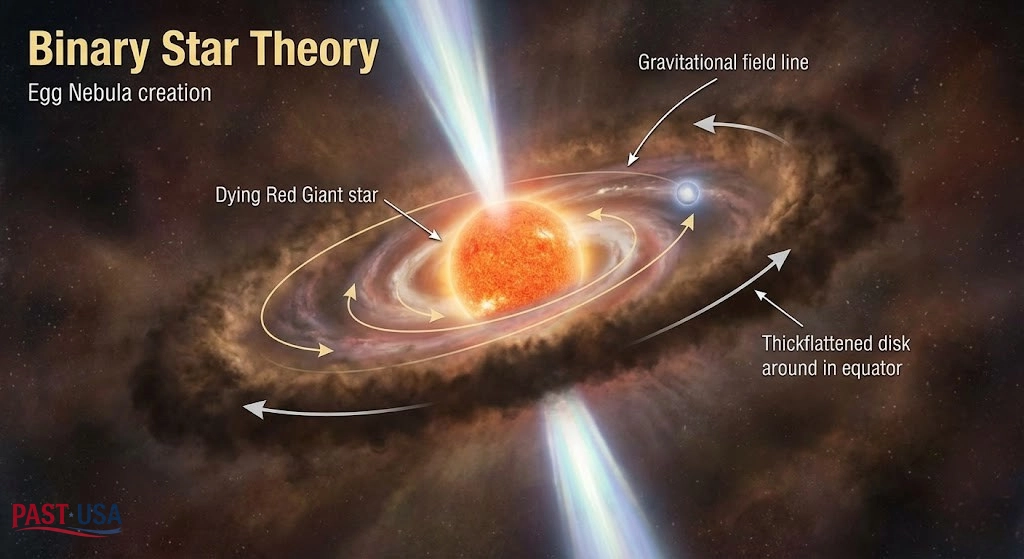
The leading theory to explain the complex geometry of the Hubble Egg Nebula image is that the central object is not one star, but two.
Many astronomers believe a binary companion star is orbiting the dying Red Giant. As the giant star puffs out gas, the gravity of the second, smaller star acts like a cosmic whisk. It shapes the ejecta into spirals or creates the flattened disk (the “doughnut”) around the star’s equator.
Furthermore, the interaction between the two stars could create powerful magnetic fields. These fields act like launch rails, channeling gas and light out of the system’s poles at incredible speeds, creating the twin “searchlight” jets.
While we cannot see this companion star through the thick dust, the circumstantial evidence provided by the structures in the Hubble image strongly points to its existence. It takes two to tango, creating such intricate cosmic art.
Why Carbon Matters
When we look at the Hubble Egg Nebula image, we are looking at the origin story of the stuff that makes up life.
The dusty shells surrounding the nebula are incredibly rich in carbon. The central star, in its death throes, has been busy fusing helium into carbon and dredging that material up to the surface to be expelled.
These dust grains essentially cosmic soot and microscopic diamonds are being blasted out into the interstellar medium. Eventually, this nebula will dissipate, mixing its carbon-rich dust with the general clouds of the Milky Way. Millions or billions of years from now, that dust might clump together as part of a new solar system, forming comets, asteroids, planets, and perhaps, living beings.
Carl Sagan famously said we are made of “star stuff.” The Egg Nebula is a factory currently manufacturing that stuff.
Hubble vs Webb: Why We Still Need Visible Light
In 2026, the James Webb Space Telescope (JWST) is dominating headlines with its infrared capabilities. This might lead some to wonder why an older Hubble image is trending.
The trend serves as a vital reminder of complementary science. JWST sees in infrared heat radiation. If JWST looked at the Egg Nebula (and it has targeted similar objects), it peers right through much of the dust to see the warmer inner workings.
However, Hubble sees primarily in visible light the same light our eyes see. The stunning concentric rings in the Hubble Egg Nebula image are visible specifically because the dust grains are the perfect size to scatter and reflect visible starlight.
To fully understand an object like this, astronomers need both. They need Hubble to see the intricate structure of the cold, reflected dust shells, and they need Webb to pierce the veil and analyze the chemistry and heat source inside. The current viral nature of the Hubble image emphasizes that visible light astronomy retains a unique power to connect with human perception.
Conclusion: A Timeless Echo of Cosmic Evolution
The sudden viral resurgence of the Hubble Egg Nebula image in February 2026 is a fascinating cultural and scientific moment. It reminds us that in a world dominated by fleeting trends and instantaneous information, the deep time of the cosmos still holds a profound grip on the human imagination.
This image is more than just a pretty picture resembling a breakfast food. It is a crime scene photo of stellar homicide. It is a historical document charting thousands of years of thermal pulses. It is a laboratory for understanding fluid dynamics on a scale impossibly larger than anything on Earth.
As you gaze at those ghostly ripples in your social media feed today, remember that you are looking at our own sun’s distant future. In about 5 billion years, our solar system may look very similar to the Hubble Egg Nebula image to an alien astronomer watching from afar a beautiful, transient puff of cosmic smoke signaling the end of an era.
Until then, keep sharing the wonders of the universe, and keep looking up.
Checkout More trending informational articles on our Website like Hood Stock and Block Chain Technology.


Pingback: Heartbreak in Hollywood: James Van Der Beek Dead at 48