
In an era dominated by hyper-complex meteorological algorithms, satellite data, and AI-driven climate modeling, there is something profoundly comforting and undeniably bizarre about a nation pausing collectively to ask a large ground squirrel for weather advice. Yet, here we are again. The search trends are spiking, social media feeds are flooded with memes of Bill Murray, and the eyes of America are fixed firmly on a small borough in western Pennsylvania.
Welcome to Groundhog Day 2026.
This year’s celebration feels particularly poignant. As the mid-2020s push forward, bringing rapid technological change and global uncertainty, the steadfast rhythm of this centuries-old tradition offers a communal anchor. Whether you are desperate for an end to the winter gloom or hoping for six more weeks of skiing weather, Groundhog Day 2026 has captured the cultural zeitgeist once again.
This comprehensive report will dive deep into the events of today, analyzing Punxsutawney Phil’s 2026 decree, comparing him with his furry rivals across the continent, exploring the surprisingly deep history of the day, and pitting the rodent’s mystical powers against hard meteorological science.
The Main Event: Punxsutawney Phil’s 2026 Decree
The epicenter of the action, as always, is Gobbler’s Knob in Punxsutawney, Pennsylvania. The atmosphere in the pre-dawn hours of February 2, 2026, was electric, a stark contrast to the biting February chill. Thousands of revelerssome locals, many tourists who made the pilgrimage gathered, chanting “Phil! Phil! Phil!” as fireworks burst overhead, cutting through the winter darkness.
The top-hatted members of the Inner Circle, the elite group tasked with translating “Groundhogese,” ascended the stage. The tension was palpable. The stakes for Groundhog Day 2026 felt strangely high after a particularly erratic winter across much of the United States.
At roughly 7:25 AM ET, the moment arrived. Punxsutawney Phil, the undisputed king of weather-predicting marmots, was hoisted from his simulated tree stump burrow. He was placed on the dais, and the world waited.

The verdict for Groundhog Day 2026?
Phil did not see his shadow.
According to the ancient folklore that governs this ritual, the lack of a shadow signifies that winter’s icy grip is loosening. The official proclamation, read with booming theatricality by the Inner Circle president, declared that the clouds over Gobbler’s Knob had done their duty. Therefore, America can prepare for an Early Spring.
The crowd erupted. In a year where many regions have battled severe ice storms and polar vortex incursions, the promise of an early thaw was met with widespread jubilation. The news quickly trended globally, with “Early Spring” and “Groundhog Day 2026” dominating platforms from X (formerly Twitter) to TikTok.
Beyond Punxsutawney: The 2026 Rodent Consensus
While Phil is the media darling, he is far from the only game in town. A veritable army of prognosticating beasts across North America offered their own takes on the Groundhog Day 2026 forecast. Analyzing these regional differences often provides a more chaotic, yet entertaining, picture of the continent’s weather future.
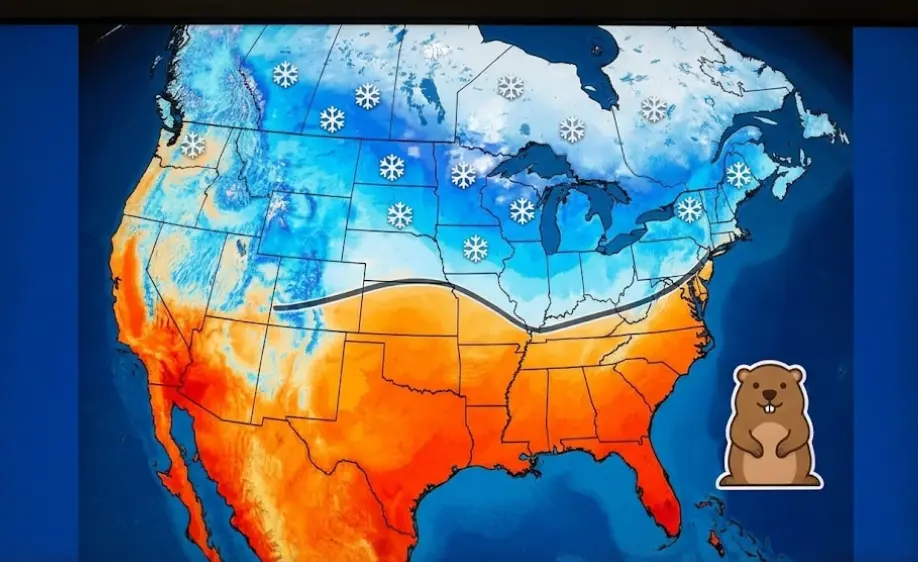
Staten Island Chuck (New York)
Often cited as having a higher accuracy rating than his Pennsylvania cousin, Staten Island Chuck emerged at the Staten Island Zoo to a large crowd of New Yorkers. In a move that solidified the morning’s optimism, Chuck agreed with Phil. No shadow was seen in New York City, doubling down on the prediction of an early spring for the Northeast corridor.
General Beauregard Lee (Georgia)
Down South, at the Dauset Trails Nature Center, General Beauregard Lee handles the forecast for the southeastern United States. The South has already experienced a milder-than-average winter in 2026, and the General confirmed the trend. He too, saw no shadow, signaling that sweater weather in Atlanta might be ending very soon.
Wiarton Willie (Canada)
Our neighbors to the north watch Wiarton Willie in Ontario eagerly. Canadian winters are no joke, and the stakes for an early spring are arguably higher there. In a surprising twist for Groundhog Day 2026, Willie did see his shadow. This split decision introduced a note of caution for the northern Midwest and Canada, suggesting that while the US might thaw, the Great White North has six more weeks of winter to endure.
The Verdict Analysis
The 2026 consensus leaned heavily toward an early spring, particularly in the United States. It is rare that the major American groundhogs align so perfectly, adding to the sense of certainty among the superstitious that warmer days are truly just around the corner.
The Deep Roots: Why We Do This
To understand the massive engagement with Groundhog Day 2026, we have to look backward. This isn’t just a quirky marketing stunt by the Punxsutawney Chamber of Commerce; it’s a tradition with roots deep in European history.
The holiday originates from Candlemas Day, a Christian feast celebrating the presentation of Jesus at the Temple, occurring 40 days after Christmas. In many parts of Europe, particularly Germany, Candlemas became associated with weather prognostication related to the planting season. It is a “cross-quarter” day, marking the midpoint between the winter solstice and the spring equinox.
An old English/Scottish saying laid the groundwork: “If Candlemas Day be fair and bright, / Winter will have another flight; / But if it be dark with clouds and rain, / Winter is gone, and will not come again.”
The Germans introduced an animal into the mix. Originally, they relied on badgers or hedgehogs. If the animal emerged from hibernation on a sunny Candlemas and saw its shadow, it would be frightened and retreat back inside, indicating winter would continue. A cloudy day meant it stayed out, signaling spring.
When German settlers arrived in Pennsylvania in the 18th and 19th centuries, they brought this tradition with them. Finding a scarcity of badgers, they adapted the lore to the abundant local groundhog (or woodchuck). The first reported news of a Groundhog Day 2026 observance in Punxsutawney occurred in 1886 in the local newspaper, The Punxsutawney Spirit. The rest is history.
The Science vs. The Shadow: Meteorological Reality of 2026
While Groundhog Day 2026 provides excellent entertainment, how does Phil’s prediction stack up against actual science?
If you ask a meteorologist at the National Weather Service (NWS) about the groundhog’s accuracy, they will likely politely roll their eyes. Statistically, Punxsutawney Phil’s accuracy rate hovers somewhere between 35% and 40% over the past century. You would genuinely be better off flipping a coin to predict the arrival of spring.
The concept of an “early spring” is also meteorologically vague. The astronomical spring doesn’t begin until the vernal equinox in mid-March, regardless of what a rodent decides in early February.
So, what is the real scientific outlook for the remainder of winter 2026?
Atmospheric scientists looking at Groundhog Day 2026 are less concerned with shadows and more concerned with global climate patterns. The winter of 2025-2026 has been characterized by a neutral ENSO (El Nino-Southern Oscillation) phase, leaning slightly toward La Nina conditions.
Typically, this pattern creates a highly variable jet stream. For the remainder of February and March 2026, long-range NOAA forecasts suggest a divided nation. The southern tier of the US is indeed looking at warmer-than-average temperatures, aligning with General Beauregard Lee’s prediction. However, the Northern Plains and the Pacific Northwest are forecast to remain under a trough of lower pressure, keeping temperatures cooler and permitting continued winter storms.
Ironically, Phil’s 2026 “Early Spring” prediction might end up being technically correct for the mid-Atlantic region where he lives, even if it’s wrong for Minnesota or Maine. The groundhog, it seems, plays the averages.
The Cultural Phenomenon in 2026
You cannot discuss Groundhog Day 2026 without acknowledging the massive cultural footprint of the event, largely cemented by the 1993 film Groundhog Day, starring Bill Murray.
The movie fundamentally changed the meaning of the phrase. Before 1993, “Groundhog Day” was just a date on the calendar. Today, it is a universal metaphor for being stuck in a monotonous time loop, doomed to repeat the same mistakes.
In 2026, this metaphor resonates deeply. As society grapples with ongoing political stalemates, cyclic economic concerns, and the feeling that history is constantly repeating itself, the “Groundhog Day” meme format is more relevant than ever. Social media platforms today are flooded not just with pictures of Phil, but with commentary using the day to express frustration with the status quo.
Yet, the film also ends with hope the idea that one can eventually break the cycle through self-improvement and kindness. Perhaps that is the deeper resonance of Groundhog Day 2026: a collective wish that this spring will bring not just warmer weather, but a genuine fresh start.
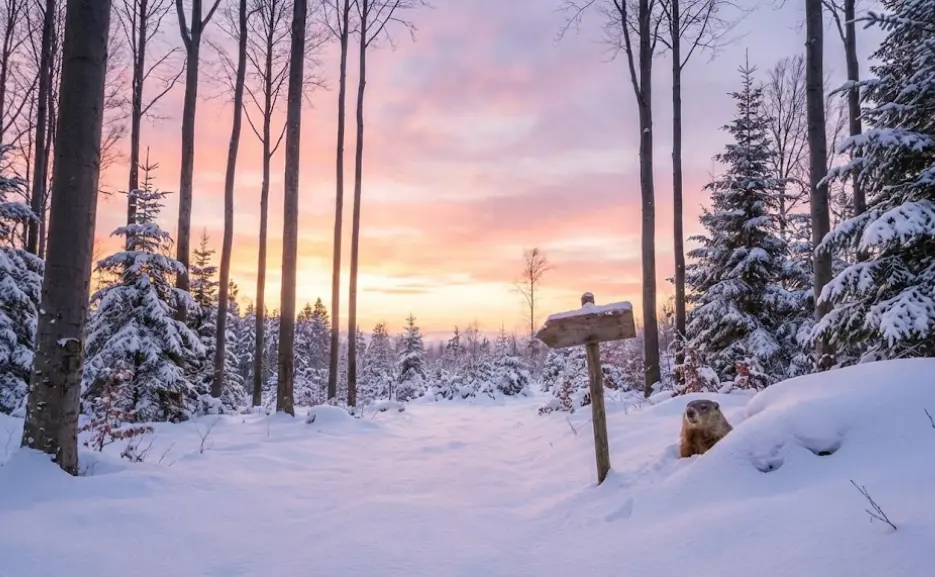
The Economics of the rodent
It would be naive to ignore the financial reality of the day. Groundhog Day 2026 is big business.
For the town of Punxsutawney, a small community of under 6,000 residents, this single day is their economic lifeblood. The influx of 20,000 to 40,000 tourists (depending on the year and the weather) fills hotels for a hundred-mile radius, packs restaurants, and moves immense amounts of merchandise ranging from plush groundhogs to “Phil’s Shadow” brand hot sauce.
The festival has expanded significantly over the decades. It’s no longer just the morning reveal. It is a multi-day festival involving ice carving, talent shows, banquets, and community dances. The town masterfully leverages nostalgia and kitsch to create a bucket-list destination experience.
Furthermore, in the digital age of 2026, the livestream advertising revenue and corporate sponsorships tied to the various groundhog events across the country generate millions of dollars. It turns out that weather prognostication via rodent is a recession-proof industry.
Modern Challenges: Climate and Ethics
Despite the fun, Groundhog Day 2026 faces modern scrutiny that wasn’t present a century ago.
The most pressing issue is climate change. As winters globally become shorter and warmer, the biological clocks of hibernating animals are shifting. Some scientists argue that groundhogs are naturally emerging earlier than February 2nd in many regions, making the specific date of the ceremony increasingly arbitrary. The tradition relies on a definition of “winter” that is rapidly changing.
Then there is the ethical angle. Every year, animal rights organizations like PETA protest the event. They argue that subjecting a shy, burrowing animal to bright lights, loud crowds, and being handled by humans is cruel and unnatural. They frequently suggest replacing Phil with an animatronic robot or an AI representation.
While the Inner Circle staunchly defends their care of Phil claiming he lives in a climate-controlled “zoo” and receives top-tier veterinary attention the conversation around using live animals for entertainment is louder in 2026 than ever before. While the tradition seems secure for now, one wonders what Groundhog Day will look like in 2036 or 2046.
Conclusion: The Enduring Need for Hope
As the sun sets on Groundhog Day 2026, the fervor will die down. The tourists will leave Punxsutawney, and Phil will return to his comfortable enclosure, his job done for another 364 days.
We know, rationally, that a groundhog cannot predict the weather. We know that the jet stream and ocean temperatures will dictate when spring truly arrives. Yet, millions of us tuned in anyway.

Why? Because we need the break. We need the silliness. In a world that often feels painfully serious, there is immense value in a shared, harmless delusion. We need the connection to our agrarian past, a reminder of a time when we were more deeply tuned into the subtle shifts of the seasons.
Most of all, we need hope. Whether Phil sees his shadow or not, Groundhog Day serves as a psychological midpoint. It is a reminder that no matter how dark and cold the winter has been, the days are getting longer, the sun is getting higher, and spring eventually, inevitably is coming.
Punxsutawney Phil has promised us an Early Spring for 2026. Now, we wait to see if nature agrees.
Also See the Controversy About the Viral Dress of Chappell Roan at Grammys 2026.
Pingback: Savannah Guthrie Mom Missing: Crime Scene Declared